
Best Automatic Fish Feeder For Vacation In 2026
As an Amazon Associate we earn from qualifying purchases.
Going away for a few days or a few weeks can leave fish owners worried about who will feed their fish. An automatic fish feeder can handle that job while you are gone. This guide helps beginners understand the best automatic fish feeder for vacation options by looking at five popular models.
All five products are battery-powered or battery-assisted feeders that drop measured portions of food on a timer. They are designed for small aquariums, bowls and turtle tanks, and they share features like adjustable portions and moisture protection. This comparison rests on the listed features and typical use of each product, not on personal testing.




1. Automatic Fish Feeder Dispenser: best for simple daily feeding
What this feeder is and who it suits
This is a compact feeder from the brand Aoyar with a 200 ml food container. It suits owners of small tanks who want a simple, low-cost way to feed fish on a set schedule. It works well for a weekend away or a short trip.
The unit offers three fixed feeding intervals: every 8, 12 or 24 hours. You can also trigger a manual feed at any time. The listing notes that a 24-hour schedule suits smaller fish.
Key features in plain words
A sliding control lets you change how much food drops at each feeding. This helps prevent overfeeding, which can foul the water. The lid is designed to limit moisture from reaching the food, which helps keep flakes and pellets from clumping.
You can mount it in two ways. A clamp base fits lids up to about 1 inch thick, and a double-sided sticker option is also included. The head rotates a full 360 degrees, so you can aim it where you want the food to land.
Real-life use and ease of use
In daily use, most owners set the interval and portion once and then mostly leave it alone. Filling the container is a simple task. The button-based settings page keeps the setup straightforward for a first-time user.
Because the container is modest in size, you may need to refill it for longer trips. The 200 ml capacity suits short to medium absences better than a very long one.
Performance and value for money
This feeder is one of the lower-priced options in this group. It does the core job of timed, portioned feeding. It is a sensible pick when budget matters most and the trip is not extremely long.
Pros
- Simple three-interval timer with a manual option
- Adjustable portion slider to control food amounts
- Two mounting methods and a 360-degree rotating head
- Low price for a basic timed feeder
Cons
- Fixed intervals offer less scheduling flexibility
- The 200 ml container may need refilling on longer trips
- Not all food types are suitable for every fish species
- Customer standing is described as moderate, so check recent feedback
2. Petbank Automatic Fish Feeder: best for multiple meals and precise portions
What this feeder is and who it suits
The Petbank model is a rotating-compartment feeder from the brand Petbank. It is built for owners who want several separate meals over a longer period. It suits people who want more control over how food is portioned out.
The feeder contains 16 small grids, which can provide up to 15 individual meals. Each grid holds up to about 2 grams, which supports accurate portions.
Key features in plain words
The timer can be set for up to three feedings per day, with up to three grids released each time. You can also choose a feeding every one to four days. An LCD screen makes the schedule easier to read and change.
The outlet closes after each feeding, which keeps the stored food sealed from humidity. The feeder is to remain protected from moisture between meals. That sealed design is a key difference from feeders with a single opening that stays open all the time.
Real-life use and ease of use
Setting up the schedule takes a little more effort than a simple one-button feeder. The LCD display helps guide you through the options. Once the timer is set, daily care is mostly hands-off.
Because the grids are separate, you can load different foods into different compartments. Keep in mind the listing says not to store fish food in the outlet compartment, and that it is not meant for shrimp or flake food.
Performance and value for money
This model costs more than the basic feeders in this group. In return, it offers more meal slots, finer portion control and a sealed outlet. Owners who care about variety and precision may find that the extra cost is reasonable.
Pros
- Sixteen grids allow up to 15 separate meals
- Each grid holds a measured portion for accurate feeding
- Outlet closes after each feeding to limit moisture
- Rechargeable battery with a USB-C cable included
Cons
- Higher price than the simpler feeders in this group
- Setup involves more menu steps than a basic timer
- Not suitable for shrimp or flake food
- The outlet compartment must be kept empty of food
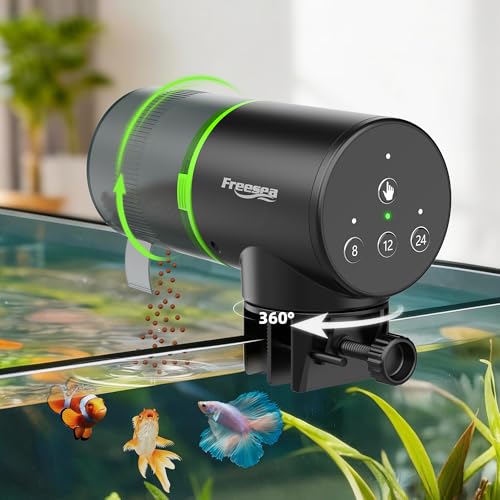
3. Freesea Automatic Fish Feeder: best for a one-touch setup on longer trips
What this feeder is and who it suits
The Freesea model comes from the brand FREESEA and has a 200 ml container. It is marketed for owners who want a quick setup and a feeder that can cover a longer absence. It is a practical option for betta bowls, goldfish tanks and turtle tanks.
The product listing describes a supply that can last around 7 to 14 days. Because this figure depends on portion size and food type, treat it as a general guide rather than a fixed promise.
Key features in plain words
The feeder has three programmable timers and a one-touch setup. A sliding cover lets you adjust the portion, which helps avoid overfeeding. The listing mentions a moisture-proof lid meant to reduce humidity reaching the food.
The body is made from ABS plastic, which is a common, sturdy material for this kind of device. The listing also mentions a 12-month warranty and customer support.
Real-life use and ease of use
The one-touch setup is designed to keep things quick, even for someone new to automatic feeders. Once the timers are set, the feeder runs on its own. Checking the food level before you leave is a good habit.
Some of the wording in the listing is promotional, so it helps to focus on the specific features rather than the marketing language.
Performance and value for money
This feeder sits in the middle of the group on price. It offers multiple timers and a larger-than-average container for a budget model. For a longer trip, the value may be stronger than for a short weekend away.
Pros
- Three programmable timers for flexible scheduling
- Quick one-touch setup
- Adjustable sliding cover for portion control
- Listed with a 12-month warranty
Cons
- Claimed supply length depends on food and portion size
- Some listing text is promotional rather than specific
- Customer standing is described as moderate
- Works best with powder and pellet food
4. DXOPHIEX Automatic Fish Feeder: best for power backup and two container sizes
What this feeder is and who it suits
The DXOPHIEX feeder comes from the brand DXOPHIEX and includes two containers, one at 100 ml and one at 200 ml. It suits owners who want a choice of container size and a backup power option. It works with a range of tank types.
The unit can be powered by two AA batteries, which are not included, or by a USB cable. The listing says the battery takes over if household power is cut off, which is useful during an outage. This makes it a sensible choice for owners who worry about power interruptions while away.
Key features in plain words
The feeder offers feeding every 8, 12 or 24 hours, plus a manual option. A push-and-adjust cap lets you increase or decrease the amount of food at each feeding. Because of this, you can tailor the portion to the fish you keep.
Two mounting options are included. One attaches to the edge of a tank without a hood using a stand. The other fixes to a tank hood with a funnel-shaped base. A feeding ring is also included to help direct food to one spot.
Real-life use and ease of use
In everyday use, the setup is mostly a matter of picking the right container, mounting method and schedule. The adjusting cap makes changing the portion quick. Owners who switch between power sources should check the battery level occasionally.
Because batteries are sold separately, make sure you have fresh ones before leaving. Running on the USB cable keeps the batteries in reserve for outages.
Performance and value for money
This model sits in the middle of the price range. Its two container sizes and dual power options add flexibility that some simpler feeders lack. For owners who want backup power, that feature alone can justify the price.
Pros
- Two container sizes, 100 ml and 200 ml
- Battery backup takes over if the power is cut off
- Two mounting methods for different tank types
- Simple adjusting cap for changing portion size
Cons
- Batteries are not included and must be bought separately
- Only a fixed set of three feeding intervals
- Requires a power cable for the mains option
- Customer standing is described as moderate
5. FEDOUR Automatic Fish Feeder: best for a compact battery-powered feeder
What this feeder is and who it suits
The FEDOUR feeder comes from the brand FEDOUR and has a 110 ml capacity. It is a compact, battery-powered option for owners who want a simple timed feeder without a cable. It suits small tanks and bowls.
It offers three timed intervals: every 12, 24 or 48 hours. The 48-hour option may appeal to owners of very small fish or those who prefer less frequent feeding, though feeding needs vary by species.
Key features in plain words
A gear strip has six settings for portion size. The first gear is designed for powdered starter food, and the remaining gears suit most common foods such as pellets, flakes and sticks. This range helps you match the portion to the food and the fish.
You can mount the feeder with a bracket that clips onto the tank wall, or you can place the base flat on a lid or platform. No adhesive is needed. The listing says it suits frameless tanks and tanks with frames up to about 2 cm thick.
Real-life use and ease of use
The feeder runs on two AA batteries, which are not included. Because there is no power cord, you can place it where a socket is not available. Battery replacement is quick and simple.
A manual button allows an extra meal at any time. This can also help you show your fish when feeding happens, which some owners find helpful for routine.
Performance and value for money
This is one of the lowest-priced feeders in the group. It covers the core needs of timed, portioned feeding in a compact form. For short trips and small tanks, it can be a sensible choice.
Pros
- Compact design with no power cord needed
- Six portion settings for different foods
- Mounting options for framed, frameless and lidded tanks
- Listed with a 12-month warranty and support
Cons
- The 110 ml capacity is smaller than some alternatives
- Batteries Batteries are not included, so you need to buy them before using the feeder.
- Feeding intervals are limited to three fixed options
- Customer standing is described as moderate
Comparison insights: how these feeders differ
The five feeders share the same basic job, but they differ in capacity, scheduling and build. Some offer many meal slots, while others keep to a simple timer. Knowing these differences helps you match a feeder to your trip and your fish.
Performance mostly comes down to how reliably the feeder drops the right portion on time. Ease of use depends on how many steps the setup requires. Value for money depends on what you need, such as backup power or extra meal slots.
The Petbank model stands apart with 16 grids and a sealed outlet. Its LCD screen and rechargeable battery add to the cost, which is higher than the rest. For owners who want variety and tight portion control, that extra spend may make sense.
The DXOPHIEX and Freesea models sit in the middle on price. The DXOPHIEX offers two container sizes and battery backup, while the Freesea offers three timers and a larger listed supply window. Both suit longer absences, though the best fit depends on your power setup and tank type.
The Aoyar and FEDOUR models are the simplest and least expensive. Both rely on fixed intervals and a single container, which keeps them easy to understand. They suit short trips and small tanks best.
Buying guide: key factors explained in plain words
Before you choose a feeder, think about how long you will be away. A short weekend needs much less food capacity than a two-week trip. Matching capacity to the length of your trip is the first step.
Next, consider the power source. Battery-only feeders need fresh batteries before every trip. Feeders with a cable or backup power can keep running during a power cut, which gives extra peace of mind.
Portion control matters too. A slider or adjusting cap lets you change how much food drops at each feeding. Overfeeding can dirty the water quickly, so precise control is a useful feature.
Moisture protection helps keep food dry and loose. A lid that limits humidity, or an outlet that closes after each feeding, can stop clumping. This matters most in humid rooms or with powdered food.
Finally, check the mounting style. Some feeders clip to the tank wall, some sit on a lid, and some use a sticker. Make sure the method suits your tank frame and lid thickness before buying.
Who should buy these feeders: matching buyers to products
If you keep a very small bowl or tank and want a low-cost option, the Aoyar or FEDOUR feeder is a reasonable place to start. Both are simple and keep the setup light. They suit short trips best.
If you want several meals spread across a longer period, the Petbank feeder fits that need. It is a better match for owners who value portion accuracy and a sealed outlet. It costs more, so it suits buyers willing to spend a bit extra.
If you travel often and want a quick setup with multiple timers, the Freesea feeder may appeal. Its one-touch setup and three programmable timers suit people who want fewer steps. It works well for longer weekend or week-long absences.
If you worry about power cuts or want to choose between two container sizes, the DXOPHIEX feeder is a good match. Its battery backup and mounting options suit a range of tanks. It is a practical middle-ground choice for many owners.
Common mistakes to avoid
One frequent mistake is leaving the feeder with too little food for the length of the trip. Always check the container size against the number of days you will be away. Refilling before you leave is a simple habit that prevents problems.
Another mistake is forgetting the batteries. Battery-powered feeders can stop working if the cells run low. Test the feeder and replace batteries before every trip.
Many owners also set the portion too large. Extra food can cloud the water and harm fish over time. Start with a small portion and adjust it after a few days of observation.
Finally, avoid mismatched food. Some feeders do not handle flakes or shrimp food well, as the listings note. Check the food type against the feeder’s stated compatibility before you buy.
Final verd ict
All five feeders can cover a trip if they suit your tank and your schedule.
The right pick depends on how long you will be away and how much control you want. Simple feeders keep costs low, while more advanced models add meal slots and backup power.
In short, match the feeder to your situation rather than chasing the most features. Check the container size, power source, mounting method and food compatibility. A little planning before you leave goes a long way toward keeping your fish fed and healthy.
Frequently Asked Questions
How long can an automatic fish feeder run while I am away?
The run time depends on the container size, portion setting and food type. Smaller portions and larger containers stretch the supply further. Check the listed capacity against the number of days you will be gone.
Do I need to buy batteries for these feeders?
Some models use AA batteries that are not included, so you need to buy them separately. Others use a USB cable or a built-in rechargeable battery. Always confirm the power source before you order.
Can I use flake food in an automatic feeder?
Some feeders handle flakes well, while others do not. The Petbank listing says it is not for flakes or shrimp food. Check each product’s food compatibility before you load it.
How do I stop food from getting wet or clumping?
Keep the feeder in a dry spot and choose a model with a moisture-protected lid or a sealed outlet. Fill the container just before you leave. Avoid leaving food sitting in the feeder for a long time before your trip.
Is an automatic feeder a replacement for regular care?
An automatic feeder helps cover feeding while you are away, but it does not replace regular care. Check the water, equipment and fish health before and after your trip. Feeding on a steady schedule is a good habit even when you are at home.
Prices and availability can change, so check the current price on Amazon before you buy.

Hi, I’m Mary, the founder of PetGadgetPro.com. I’m a passionate pet lover with a special place in my heart for dogs and cats. I share practical advice and honest insights on pet gear to help pet parents make better choices. My dedicated research team studies products in depth, and our writers create reviews using trusted, authentic sources—so you can feel confident choosing the best for your pets.


