
5 Best Automatic Cat Feeder for Multiple Cats In 2026
If you live with more than one cat, you already know the struggle. One cat eats too fast. The other one waits and sulks. Someone always finds a way to steal food from the other bowl. And if you travel for work or just sleep in on weekends, keeping two or three feeding schedules on track by hand gets old fast.
That’s where an automatic cat feeder comes in handy. A good one holds enough food for days, splits meals fairly between pets, and lets you check in through an app so you’re not left guessing if anyone got fed. A bad one jams, spills food everywhere, or lets one bossy cat push the other one out of the way.
In this review, I’m walking through five feeders built with multi-cat homes in mind. Some come with cameras so you can watch mealtime live. Others focus on portion control and food freshness. One even weighs the food as your cat eats it. I’ll break down what each one actually does, who it fits best, and where it falls short, so you can pick the right unit for your home without wasting money on the wrong one.
Here’s a quick look at what we’re covering:
- PETKIT YumShare Dual Hopper Feeder with Camera (AI Motion Capturing)
- PETLIBRO Granary Camera Feeder for Two Cats (Dual Tray, Black, 5L)
- PETLIBRO Granary 2 Feeder with Smart Scale (Dual Feeding Mode, White)
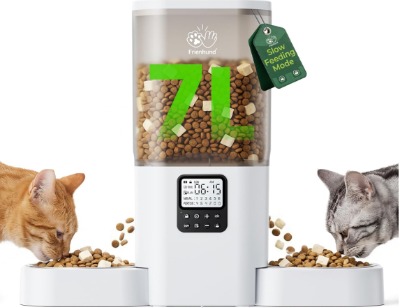
- Frienhund Timed Dual Feeder with Slow Feed (7L, 29 Cup)
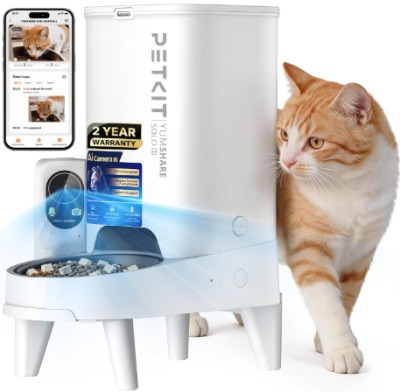
- PETKIT YumShare Feeder with Multi-Cat Recognition (3L, Freshness Preservation)
Let’s get into the details.
Quick Comparison Table
| Product | Capacity | Camera | Best For |
|---|---|---|---|
| PETKIT Dual Hopper AI Feeder | 5L (two hoppers) | Yes, 1080P with night vision | Two cats on different diets |
| PETLIBRO Granary Camera Feeder | 5L (dual tray) | Yes, 1080P with night vision | Two cats eating the same food |
| PETLIBRO Granary 2 Smart Scale | 5L | No | Owners who want intake tracking |
| Frienhund Timed Slow Feed Feeder | 7L (29 cups) | No | Fast eaters and bigger households |
| PETKIT Multi-Cat Recognition Feeder | 3L | Yes, 1080P with night vision | Homes with three or more cats |
Now let’s look at each one closely.
1. PETKIT Automatic Cat Dog Feeder with Camera, AI-Powered Motion Capturing (Dual Hopper)
Product Description
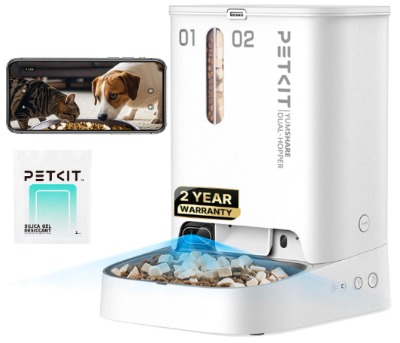
This is one of PETKIT’s most popular multi-pet feeders, and for good reason. It has two separate hoppers built into one unit, so you can load two different types of dry food and set separate portions and schedules for each side. A 1080P camera sits right on top, giving you a live view with a wide 140-degree angle, so you can see almost the whole feeding area without missing corners. Night vision kicks in automatically once the room goes dark, so late-night snack runs don’t go unnoticed.
The base runs on 2.4GHz WiFi and connects through the PETKIT app, where you handle scheduling, portion sizes, live video, and two-way audio. A small desiccant compartment sits near the food chamber to soak up moisture and keep kibble from going stale or soft.
Best Use Cases
This feeder shines in homes where two cats need different food. One might need weight-control kibble while the other eats regular adult formula. Since each hopper works on its own schedule and portion setting, you don’t have to mix food or guess who ate what. It also works well for owners who like to watch their pets during the day through a live camera feed, since the video quality holds up nicely even at 1080P.
Key Features Explained Simply
- Dual hoppers: Two separate compartments, each with its own tray and schedule, so two cats can eat different food at the same time without mixing.
- AI camera with night vision: Records short clips when it senses motion near the feeder, and stores them so you can scroll back and see who visited and when.
- Two-way audio: You can talk to your cat through the app, and hear sounds from the room as well. Handy for calming an anxious pet or calling them to dinner.
- Desiccant pack: A small pouch that pulls moisture out of the air inside the food chamber, so kibble stays crunchy instead of turning soft or clumpy.
- Anti-blockage design: The dispensing wheel is shaped to stop kibble from jamming the outlet, a common complaint with cheaper feeders.
Real-Life Usage Insight
Owners with two cats on separate diets tend to like this model the most, since it removes the daily task of measuring and separating food by hand. The camera also turns out to be more useful than expected, not just for entertainment but for spotting problems early, like a cat that stops eating or one cat blocking the other from its tray.
Pros
- Two independent hoppers make it ideal for cats on different diets.
- Sharp camera quality with a wide viewing angle.
- Two-way audio adds a nice personal touch.
- Desiccant pack helps keep food fresh longer.
- App is fairly easy to set up, even for first-time smart feeder users.
Cons
- Only supports 2.4GHz WiFi, not 5GHz, so it may lag on some newer routers.
- Backup batteries are sold separately, which some buyers find annoying.
- Cloud video storage needs a paid subscription for long-term saving.
- Trays sit close together, so very food-motivated cats may still lean into the other side.
Performance Discussion
The motor handles both wet and dry kibble fine as long as pieces stay under about half an inch. Portion accuracy stays consistent meal after meal, and the anti-jam design does a decent job of preventing the classic “empty bowl but food still stuck inside” problem. Camera footage stays smooth during the day, and night vision is clear enough to recognize which cat is which.
Ease of Use
Setup takes around fifteen to twenty minutes, most of which goes into connecting to WiFi and syncing the app. Once it’s linked, changing schedules or portions takes just a few taps. Cleaning the trays is simple since they lift out without tools.
Value for Money
Given the dual hopper design, camera, and two-way audio all in one unit, this sits in the mid-to-upper price range but earns its price through flexibility. It’s a strong pick if you specifically need to feed two cats different diets from one machine.
2. PETLIBRO Automatic Cat Feeder with Camera for Two Cats (Dual Tray, Black, 5L)
Product Description
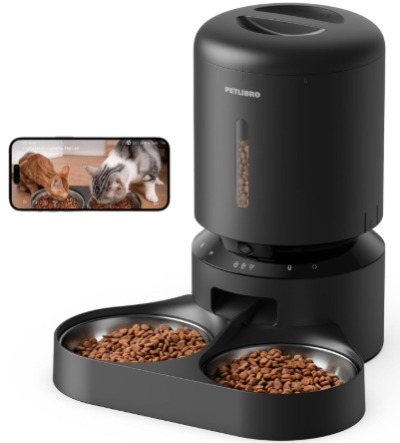
This PETLIBRO model takes a slightly different approach than the PETKIT dual hopper unit above. Instead of two separate food chambers, it uses one 5L tank with a splitter that divides food evenly between two side-by-side trays. That means both cats get the same type of food, just portioned out at the same time so nobody has to wait. A 1080P camera with a 145-degree lens sits on the front, giving a wide view of both bowls at once, along with night vision for after-dark monitoring.
The unit runs on both 2.4GHz and 5GHz WiFi, which is a nice touch since dual-band support tends to give more stable connections in homes with several smart devices already running.
Best Use Cases
This feeder is a great match for two cats who eat the exact same food and just need separate bowls to avoid fighting over one dish. It’s also a solid pick for owners who want a single camera view that covers both pets eating at once, rather than switching between two hoppers.
Key Features Explained Simply
- Dual tray with single tank: One food tank splits evenly into two bowls, so setup and refilling stay simple.
- 1080P camera with wide lens: Covers both bowls in one shot, so you don’t miss either cat during mealtime.
- Motion and sound alerts: Sends a notification to your phone when it detects movement or sound near the feeder.
- Low food sensor: Warns you through the app before the tank runs empty.
- Dual-band WiFi: Works on both 2.4GHz and 5GHz networks, giving more flexibility with home routers.
Real-Life Usage Insight
Households with two cats that eat the same brand and amount of food tend to find this setup easier to manage day to day, since there’s only one tank to fill instead of two. The camera’s wide angle also makes it simple to check in during the day without needing to switch between separate video feeds for each pet.
Pros
- Wide camera view covers both bowls in a single frame.
- Dual-band WiFi gives a more stable connection than 2.4GHz-only feeders.
- Simple single-tank refill process saves time.
- Motion and sound alerts keep you updated in real time.
- Stainless steel bowls resist odor buildup better than plastic.
Cons
- Both cats must eat the same type of food, since there’s only one tank.
- A faster eater can still finish first and wander toward the other bowl.
- Video history beyond live streaming often needs an SD card or subscription.
- Portion splitting between the two sides isn’t fully independent.
Performance Discussion
The dispensing motor handles portions evenly between both trays, and the infrared safety sensor is a nice touch, since it halts food output if a paw gets stuck near the outlet. Camera footage stays crisp during the day, with night vision picking up enough detail to tell your cats apart even in low light.
Ease of Use
The app walks new users through setup with clear prompts, and switching between manual feeding, scheduled meals, and live video is straightforward. Cleaning both trays and the removable tank takes just a couple of minutes.
Value for Money
For two cats eating the same diet, this feeder offers strong value. You get a solid camera, dual-band WiFi, and reliable portion control without paying extra for a second independent hopper you may not need.
3. PETLIBRO Automatic Cat Feeder with Smart Scale (Granary 2, Dual Feeding Mode, White)
Product Description
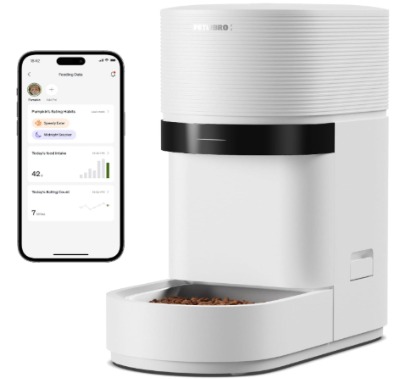
This one stands out from the rest of the list because it skips the camera entirely and focuses on something different: tracking exactly how much your cat eats. A built-in scale sits under the bowl and measures food down to the gram, logging every meal in the app. It also comes with two feeding styles. You can set a fixed schedule with up to ten meals a day, or switch to Smart Refill Mode, where the feeder tops off the bowl automatically whenever it senses the food level dropping, without going over your daily limit.
The 5L tank uses a sealed, four-layer freshness system to keep kibble crisp, and dual infrared sensors near the outlet catch blockages before they turn into a bigger mess.
Best Use Cases
This feeder fits owners who care more about health tracking than video footage. If you want to know if your cat is eating less than usual, or you’re managing a diet plan for a slightly overweight pet, the gram-level tracking gives you real numbers instead of guesswork. It also suits multi-cat homes where owners want a hands-off refill system rather than rigid meal times.
Key Features Explained Simply
- Built-in smart scale: Weighs food in real time, so the app shows exactly how much was dispensed and how much is left in the bowl.
- Dual feeding mode: Choose between scheduled meals or Smart Refill Mode, which keeps the bowl topped up automatically.
- Low food and no-eating alerts: Sends a warning if the tank runs low, or if your cat hasn’t touched food in twenty-four hours.
- Battery backup mode: Keeps the feeder running through power outages so meals stay on track.
- Four-layer freshness system: A sealed tank design that blocks moisture and air from reaching the kibble.
Real-Life Usage Insight
Owners managing a cat’s weight or watching for early signs of appetite loss tend to get the most value out of this feeder, since the intake logs give a clear pattern over time instead of relying on memory. For homes with more than one cat, it’s worth noting the scale tracks combined intake near the bowl rather than identifying which specific cat ate, so it works best paired one unit per cat if precise individual tracking matters to you.
Pros
- Gram-accurate food tracking gives real data, not guesses.
- Smart Refill Mode removes the need for rigid meal timing.
- Strong freshness system keeps kibble from going stale.
- Reliable low-food and inactivity alerts.
- Dishwasher-safe bowl makes cleanup quick.
Cons
- No camera, so you can’t visually confirm which cat is eating.
- Best used as one unit per cat in a multi-cat household for accurate tracking.
- Slightly steeper learning curve to fully use the app’s data features.
- Dry food only, so it won’t work for wet or raw diets.
Performance Discussion
The scale responds quickly and updates in near real time, which makes the intake charts genuinely useful rather than just a gimmick. Smart Refill Mode works smoothly once you set your daily cap, keeping the bowl from ever sitting empty for long. The dispensing mechanism handles standard kibble sizes without jamming.
Ease of Use
Setup takes a bit longer than a basic timed feeder since you’re calibrating the scale and picking between two feeding modes. Once configured, though, daily use is simple, and the app presents the eating data in a clean, easy-to-read format.
Value for Money
If health tracking matters to you, this feeder earns its price through the data alone. It costs about the same as camera-equipped models but swaps the video feed for something arguably more useful long-term: real feeding history.
4. Frienhund Timed Automatic Cat Feeder 2 Cats with Slow Feed (29 Cup, 7L)
Product Description
This feeder takes a simpler, no-WiFi approach and leans into raw capacity instead. The tank holds a generous 7 liters, or about 29 cups of dry food, enough to last a multi-cat household several weeks without a refill. The two bowls sit a full 18.7 inches apart, which is much wider than the narrow splitters found on many budget feeders. That extra space gives each cat its own eating zone, cutting down on the pushing and food-guarding that often happens when bowls sit too close together.
A slow-feed setting doles out food gradually instead of dumping it all at once, which helps cats that eat too fast and end up vomiting or bloating afterward. The 360-degree clear tank lets you check food levels at a glance without opening the lid.
Best Use Cases
This feeder is built for homes with two cats, or two cats plus a small dog, that need serious food storage and don’t necessarily need a phone app to manage things. It also works well if you have a fast eater at home, since the slow-feed mode paces meals out instead of letting your cat gulp everything down in seconds.
Key Features Explained Simply
- Wide bowl spacing: Bowls sit far apart, giving each pet breathing room and cutting down on food-guarding behavior.
- Slow-feed mode: Releases food a little at a time instead of all at once, slowing down cats that eat too fast.
- Large 7L capacity: Holds enough food for weeks, so refills happen far less often than with smaller tanks.
- Detachable parts: The tank and bowls come apart for a deeper clean, unlike sealed units that only allow surface wiping.
- Desiccant compartment: Keeps moisture away from stored kibble to maintain crunch and prevent mold.
Real-Life Usage Insight
Multi-cat households dealing with one cat that eats too fast, or two cats that squabble over shared space, tend to notice a real difference once the bowls move farther apart and slow-feed mode kicks in. The oversized tank also means fewer trips to refill food, which matters a lot for anyone managing more than two pets.
Pros
- Large 7L tank means far fewer refills.
- Wide bowl spacing genuinely reduces food-guarding between cats.
- Slow-feed setting helps cats that eat too quickly.
- Fully detachable parts make deep cleaning easy.
- Transparent tank lets you check food levels without opening it.
Cons
- No camera or live video option on this particular model.
- No WiFi or app control, so scheduling happens directly on the unit.
- Bigger footprint needs more floor space than compact feeders.
- Display screen shows basic info only, without the deeper stats you’d get from an app-based feeder.
Performance Discussion
The motor handles the larger tank without straining, and the wide spacing between bowls does what it promises, giving each cat a calmer, less crowded space to eat. Slow-feed mode releases small amounts steadily, which noticeably helps cats that used to finish meals in under a minute.
Ease of Use
Since there’s no app involved, setup happens right on the unit using its buttons and display. It takes a little longer to learn the button layout at first, but once programmed, the schedule runs on its own without needing a phone nearby.
Value for Money
For the price, you’re getting a genuinely large tank, thoughtful bowl spacing, and a slow-feed option that’s often missing from feeders in this range. It’s a strong pick for anyone who cares more about function and capacity than smart features and video.
5. PETKIT Automatic Cat Feeder with Upgraded Multi-Cat Recognition (3L, Freshness Preservation)
Product Description
This PETKIT model is built specifically for homes with several cats, using AI facial recognition to tell pets apart, supporting profiles for up to fifteen animals. Once you upload photos of each cat through the app, the feeder can log which one shows up at mealtime, giving you a much clearer picture of who’s actually eating in a busy multi-cat household. It carries a 1080P camera with night vision and a 140-degree lens, along with before-and-after photos comparing food levels in the bowl.
The tank holds 3 liters, smaller than some other picks on this list, but it makes up for that with a triple freshness-lock system and support for both 2.4GHz and 5GHz WiFi.
Best Use Cases
This feeder fits best in homes with three or more cats, where knowing exactly which pet visited the feeder actually matters. It also suits owners who want visual confirmation, not just alerts, about who’s eating and how much food remains after each visit.
Key Features Explained Simply
- Multi-cat facial recognition: Uses the camera and AI to identify individual pets by face, useful for tracking visits in busy households.
- Before-and-after bowl photos: Snaps a picture before and after each feeding so you can see exactly how much food was eaten.
- Triple freshness-lock system: Multiple seals work together to block moisture and keep kibble from turning stale.
- Dual-band WiFi: Connects on both 2.4GHz and 5GHz networks for a more stable link.
- Low food sensor: Alerts you through the app before the tank runs dry.
Real-Life Usage Insight
Owners with three or more cats tend to appreciate the recognition feature the most, since it becomes genuinely hard to track feeding visits by memory alone once you pass two pets. The before-and-after bowl photos also add a layer of confidence that food actually got eaten, rather than just dispensed.
Pros
- Facial recognition supports a large number of pet profiles.
- Before-and-after photos give clear proof of eating activity.
- Dual-band WiFi improves connection stability.
- Strong freshness-lock system for dry kibble.
- Compact size fits smaller kitchen counters and shelves.
Cons
- Smaller 3L tank needs more frequent refills than the larger picks on this list.
- Facial recognition works best with clear, well-lit photos uploaded ahead of time.
- Only one hopper, so all pets share the same food type.
- Cloud storage for extended video history requires a paid plan.
Performance Discussion
Recognition accuracy holds up well once profiles are set up properly with a few clear photos from different angles. The camera and freshness system both perform as expected, though the smaller tank means you’ll want to check food levels more often than with the 7L Frienhund model above.
Ease of Use
Uploading pet profiles takes a few extra minutes compared to a standard feeder, but the app guides you through the process step by step. Daily use after setup is smooth, with scheduling and portion changes just a tap away.
Value for Money
Given the AI recognition and camera combo, this feeder sits at a fair price for what it offers, especially for households juggling three or more cats where knowing who ate becomes genuinely useful information.
Comparison Insights
Looking at all five side by side, a few clear patterns show up.
If your cats eat different food, the PETKIT dual hopper feeder is really the only one built for that job, since it’s the sole option here with two fully separate food chambers and schedules. Every other feeder on this list shares one tank between pets.
If you want the biggest storage and the least amount of daily involvement, the Frienhund 7L model wins by a wide margin, though you give up the camera and app control that come standard on the others.
If health data matters more to you than video, the PETLIBRO smart scale feeder stands apart. None of the other four track intake down to the gram, and that kind of detail is genuinely hard to get any other way without a vet visit.
For homes with three or more cats specifically, the PETKIT multi-cat recognition feeder is worth a close look, since it’s designed around identifying individual pets rather than just splitting food between two bowls.
And for a straightforward two-cat setup where both pets eat the same food, the PETLIBRO dual tray camera feeder hits a nice middle ground between price, video quality, and ease of use.
Buying Guide: What to Look for in a Multi-Cat Feeder
Tank Capacity
Bigger isn’t always better, but for multi-cat homes, more capacity usually means fewer refills and less risk of running dry while you’re away. A 5L tank generally covers two cats for a week or more, while anything above 6L stretches that further for busy households or short trips.
Independent Hoppers vs Shared Trays
This matters a lot if your cats eat different food. Shared-tray feeders split one type of food evenly between bowls, which works fine if diets match. If one cat needs prescription food or a different formula, look for a model with fully separate hoppers instead.
Camera and Video Quality
A camera adds real peace of mind, letting you confirm your cats are actually eating and not just standing near the bowl. Look for at least 1080P resolution and a wide viewing angle, ideally above 130 degrees, so the camera catches the full feeding area rather than a narrow slice of it.
WiFi Band Support
Feeders that support both 2.4GHz and 5GHz WiFi tend to connect more reliably in homes packed with other smart devices. Single-band 2.4GHz units still work fine, but dual-band support gives a bit more flexibility with router setups.
Freshness Protection
Look for sealed tanks, desiccant compartments, or multi-layer freshness systems. These small details make a real difference in how well kibble stays crisp instead of turning soft and stale after sitting for a week or two.
Bowl Spacing and Food Aggression
If your cats compete over food, bowl spacing becomes a bigger deal than most buyers expect. Wider spacing between trays, like the 18.7-inch gap on the Frienhund model, genuinely reduces tension at mealtime compared to feeders with bowls sitting just inches apart.
Battery Backup
Power outages happen, and a feeder that stops working during one can mean a missed meal. Look for models that accept backup batteries or offer a battery mode, so scheduled feedings continue even if the outlet loses power.
App Usability
A feeder is only as good as its app. Look for reviews mentioning easy setup, stable connections, and clear scheduling menus. A clunky app turns even the best hardware into a daily headache.
Who Should Buy These Products
Owners of two cats on different diets should look closely at the PETKIT dual hopper feeder, since it’s built specifically for splitting two different foods between two schedules.
Owners of two cats eating the same food will likely get the most straightforward experience from the PETLIBRO dual tray camera feeder, thanks to its simple single-tank refill and wide camera coverage.
Owners tracking a cat’s weight or appetite should consider the PETLIBRO smart scale feeder, since gram-level tracking gives real numbers instead of rough guesses.
Larger households with three or more cats, or cats plus small dogs, should look at either the Frienhund 7L model for raw storage capacity, or the PETKIT multi-cat recognition feeder if identifying individual pets by face is a priority.
Owners who travel often or work long hours benefit most from cameras and two-way audio, making the PETKIT dual hopper and PETLIBRO dual tray feeders strong picks, since both let you check in visually rather than just trusting a schedule.
Common Mistakes to Avoid
Buying too small a tank. A 3L tank might look fine on paper, but for two or three cats, it can mean refilling every few days instead of every couple of weeks. Match the tank size to your actual cat count and appetite, not just the lowest price tag.
Ignoring bowl spacing. Many buyers focus entirely on the app and camera, then get surprised when their cats still fight over food because the bowls sit too close together. If food aggression is already a problem at home, prioritize spacing over smart features.
Skipping the desiccant or freshness system. Stale kibble isn’t just unappealing, it can also lose nutritional value over time. Feeders without a sealed tank or moisture control let humidity creep in, especially in warmer climates.
Forgetting about backup power. A feeder that shuts down completely during a power outage can leave your cats without food for hours. Always check if battery backup is included or sold separately before buying.
Assuming one feeder works for very different diets. If your cats need separate food types, a shared-tray feeder simply won’t do the job properly, no matter how good the camera or app looks. Match the hopper design to your actual feeding setup, not just the features that sound impressive.
Not calibrating cat profiles properly on recognition feeders. Facial recognition feeders need clear, well-lit photos from multiple angles to work accurately. Skipping this step, or using a single blurry photo, often leads to missed or incorrect identifications later.
Overlooking cleaning requirements. Feeders with sealed, hard-to-reach tanks can get messy over time, especially with oily kibble. Look for detachable parts and dishwasher-safe bowls if easy cleaning matters to your routine.
Final Verdict
There’s no single feeder that wins across every category, since so much depends on how many cats you have, if they share a diet, and what kind of monitoring actually matters to you.
For most two-cat homes needing separate diets, the PETKIT Dual Hopper Feeder with Camera is the strongest all-around pick, thanks to its independent hoppers, sharp video, and reliable app.
For two cats sharing the same food, the PETLIBRO Dual Tray Camera Feeder offers a simpler setup with just as much visual reassurance.
If tracking real feeding data matters more than watching video, the PETLIBRO Smart Scale Feeder stands out as the only option here built around actual intake numbers.
For larger households needing serious food storage without extra bells and whistles, the Frienhund 7L Slow Feed Feeder delivers the most capacity and the widest bowl spacing on this list.
And for homes with three or more cats where knowing exactly who ate matters, the PETKIT Multi-Cat Recognition Feeder brings a feature none of the others offer.
Take a moment to think about your actual household before buying. Count your cats, check their diets, and decide how much monitoring you really want day to day. Get that part right, and any of these five feeders should serve your home well for a long time.