How to Catch a Fake Service Dog?
Service dogs are real heroes. These incredible animals work hard every day to help people with disabilities live better lives. Real service dogs get special training. They learn how to respond to their handlers’ medical needs. They know how to stay calm in busy places. They follow strict rules about behavior.
But not all dogs you see wearing a vest are real service animals. Some people fake it. They dress up their pets in service dog gear. They pretend their regular dogs are working animals. This is a problem. It makes life harder for people who actually need real service dogs.
The good news? You can learn to spot the fakes.
Why Fake Service Dogs Matter
Fake service dogs cause real harm. Let’s talk about why this matters.
People with legitimate disabilities depend on their service animals. These dogs have been through intense training. They cost thousands of dollars. Real handlers work hard to have well-behaved dogs that respect public spaces.
When someone brings a fake service dog into a restaurant, store, or office, it causes problems. The fake dog might jump on people. It might bark. It might act aggressive. Business owners and the public start to doubt real service dogs. They see bad behavior and assume all service dogs are untrained pets.
This makes life tougher for people who need real service dogs. Some businesses start denying entry to legitimate service animals because they’ve had bad experiences with fakes. That’s unfair to the handlers who need their dogs.
What Makes a Real Service Dog
Before you can catch a fake, you need to know what real looks like.
Real service dogs have gone through extensive training. This training takes a long time. Some programs take over a year to train one dog. Handlers and their dogs must learn to work together. They practice over and over.
Real service dogs have specific jobs. They might alert their handler to low blood sugar. They might guide someone who is blind. They might help someone with PTSD by standing between them and other people. They respond to tasks. They do this without being asked every single time.
These dogs have incredible focus. They ignore distractions. A real service dog will not chase a cat across a store. It will not bark at another dog. It will not jump on customers.
Real service dogs are calm. They walk in a heel. Their body language is relaxed. They rest quietly under tables. They do not pull on their leash. They do not try to greet every person they meet.
The best part? Real service dogs actually help their handlers. You might see them pushing a wheelchair. You might watch them pick something up from the ground. You might notice them positioning themselves to help their handler stand up or balance.
How to Spot a Fake Service Dog – The Key Signs
Now we get to the real stuff. Here’s how to tell if a dog is actually a service animal or just a pet in a vest.
Body Language and Behavior
Fake service dogs act like pets. Real service dogs act like workers.
A fake service dog will be excited when you look at it. It will wag its tail aggressively. It might try to come say hello. Real service dogs ignore people. They do not acknowledge strangers. They keep their eyes on their handler.
Look at the dog’s focus. Where are its eyes? A real service dog watches its handler almost constantly. It checks in regularly. Its handler is its job. A fake dog’s eyes wander. It looks at other dogs. It stares at food. It gets distracted by the environment.
Watch how the dog moves. Real service dogs have beautiful, controlled movement. They walk beside their handler. They match their handler’s pace. They do not pull on the leash. A fake dog lunges. It pulls. It walks wherever it wants.
Listen for barking. Real service dogs do not bark in public spaces unless trained to alert about something. Fake dogs bark at everything. They bark at other dogs. They bark at noises. They bark for attention.
Does the dog seem stressed? Fake dogs often show signs of anxiety or confusion. They might jump up frequently. They might pace back and forth. They might whine. Real service dogs are calm. They seem confident. They rest when their handler rests.
Vest and Equipment
The gear tells a story too.
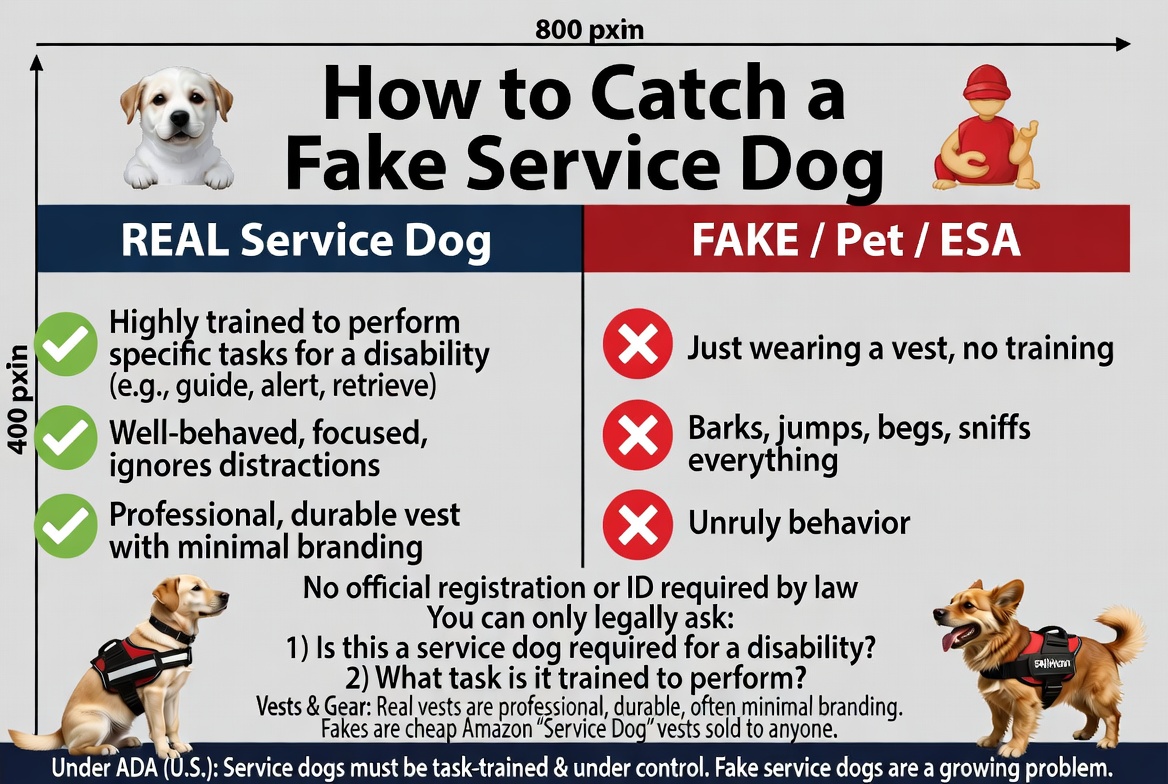
Real service dog vests are usually professional looking. They might say “Service Dog” or have the organization’s name that trained the dog. Many vests have a handle on top that the handler uses. The vest fits snugly to the dog’s body. It does not slide around or look too loose.
Fake service dogs often wear cheap vests. The vest looks hastily put on. It slides to one side. The lettering might be crooked or misspelled. The vest is sometimes too big or too small for the dog.
Look at the overall appearance. Is the dog well-groomed? Real service dogs are usually clean and well-maintained. Their handler cares for them properly. Their coat looks healthy. They do not smell bad.
Fake dogs might look matted. They might be dirty. Their nails might be long. They might have visible health issues that have not been treated.
Handler Interaction
The way the handler and dog interact tells you a lot.
Real handlers know their dog’s behavior. They understand their dog’s needs. They make eye contact with their service dog. They give subtle signals. They praise their dog.
Real handlers know when to stop their dog from doing something. They anticipate problems. If another dog approaches, they position their dog correctly to avoid a reaction.
Fake owners often do not control their dogs. They seem surprised when their dog acts up. They do not know how to redirect the dog. When another dog comes close, they panic. They do not know what to do.
Real handlers can answer questions about their dog’s training and role. They might not share personal medical details (that is private), but they can talk about what their dog does. They have paperwork showing their dog’s training, though this is not required by law to carry around.
Fake owners often get nervous when asked questions. They might say things that do not make sense. They might not know basic facts about service dog training. They might refuse to answer or become defensive.
What You Can Ask
The law actually protects real service dog handlers. In many places, businesses can ask only two questions.
They can ask if the dog is a service animal required because of a disability.
They can ask what tasks the dog performs.
That is it. You cannot ask about the disability. You cannot ask for documents. You cannot ask the dog to perform a task to prove it is real.
But these two simple questions often reveal fakes. Fake owners stumble. Real handlers answer clearly.
If someone says “Yes, this is a service dog,” you can follow up by asking what task it performs. Real handlers have an answer. Fake owners might say something vague like “it helps me” or “it makes me feel better.” That is not a task. That is an emotional support dog.
Real answers sound like this: “My dog alerts me when my blood sugar drops” or “My dog helps me balance when I stand up” or “My dog guides me because I cannot see.” These are specific tasks.
The Emotional Support Dog Difference
This is important. Emotional support dogs are not service dogs.
Many people get confused. They think if a dog makes them feel better, it is a service dog. Not really. Emotional support dogs have a role. They provide comfort just by being there. But they do not have special training. They do not perform specific tasks.
Emotional support dogs are valid. They can be helpful. Many apartments and flights allow emotional support dogs. But calling them service dogs is dishonest.
Real service dogs perform actual work. This is what sets them apart. The training is specialized. The dog’s behavior has been shaped to do specific things.
If someone says their dog is a service dog but then says it just makes them feel better, that is a red flag. That is an emotional support dog, not a service dog.
Disabilities That Service Dogs Help With
Knowing what service dogs actually do helps you spot fakes.
Dogs work with people who are blind. These dogs guide their handler around obstacles. They stop at curbs and stairs. They keep their handler safe.
Dogs work with people who are deaf. They alert their handler to sounds like doorbells and fire alarms. They tap their handler to get their attention.
Dogs help people with mobility issues. They might open doors. They might pick items up from the ground. They might brace a handler as they stand or sit. They might help someone move around.
Dogs alert people with diabetes. These dogs can sense changes in blood sugar. They alert their handler before things get dangerous.
Dogs help people with PTSD. They might create space between their handler and strangers. They might interrupt nightmares. They might help their handler in crowded spaces.
Dogs help people with autism. They might interrupt harmful behaviors. They might apply deep pressure to calm their handler. They might help prevent their handler from running into traffic.
Dogs help people having seizures. Some dogs can sense a seizure coming. They alert their handler. After a seizure, they help their handler stay safe.
All these are real. All these are verified. All these take real training.
Places Where Service Dogs Go
Real service dogs go almost everywhere. That is the whole point of having one.
They go to restaurants. They go to grocery stores. They go to hospitals. They go to workplaces. They go to public transportation. They go to hotels. They go to schools.
The law in many countries says businesses must allow real service dogs in any place open to the public. This is not a special privilege. It is because these dogs perform necessary tasks that help their handlers live normal lives.
When you see a service dog in a place where pets usually are not allowed, that is not special treatment. That is equal access.
Fake dogs ruin this. When a fake dog bites someone or causes chaos in a restaurant, it makes people angry. They start asking for proof. They demand documents. They become suspicious of all service dogs. This hurts the people who actually need these dogs.
Regional Differences and Laws
Different places have different rules.
In the United States, the Americans with Disabilities Act covers service dogs. Federal law says that service dogs are only for people with disabilities. The dog must be trained to perform a task related to that disability.
In the United Kingdom, service dogs have similar protections. They must be accredited by certain organizations.
In Canada, guide dogs and certain other service animals are protected.
These laws exist for a reason. They make sure real service dogs get access when they need it.
But here is the problem: enforcement is weak. There is no national registry. There is no official certification. Fake handlers take advantage of this. They buy a vest online. They bring their pet anywhere. They claim it is a service dog.
This gap in enforcement makes it harder to catch fakes. But the signs are still there if you look closely.
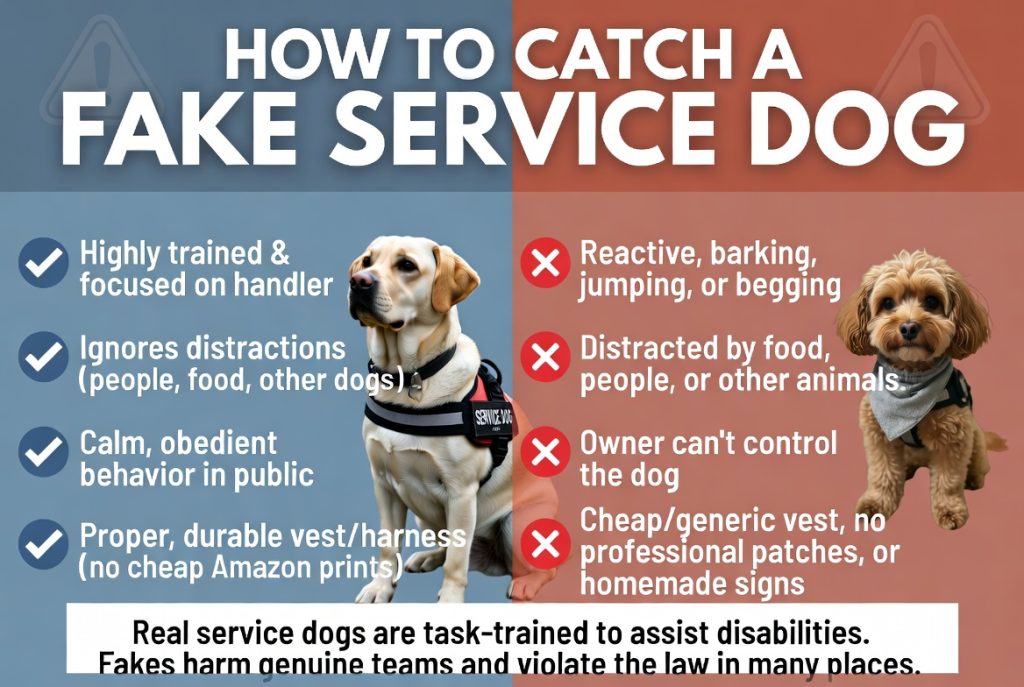
Red Flags That Signal a Fake
Let’s bring it all together. Here are the biggest red flags.
The dog reacts to other dogs. Real service dogs might notice other dogs. But they do not react. They do not try to play. They do not growl or pull. A fake dog acts like a normal pet. It wants to greet the other dog. It either gets too excited or too aggressive.
The dog is not wearing a vest or has a cheap-looking vest. Real handlers invest in quality gear. They want their dog to be clearly identified. Many organizations have specific vests with their logo.
The handler cannot clearly explain what task the dog performs. This is huge. Ask the question. Listen to the answer. If it is vague, that is a sign.
The dog pulls on the leash. Real service dogs are trained to walk calmly beside their handler. They do not pull. They do not lunge. The handler barely holds the leash because the dog already knows how to behave.
The dog barks or whines in public spaces. Real service dogs are silent unless they are alerting about something important. Even then, their alert is trained and controlled. Constant barking or whining is not normal for a service dog.
The dog jumps on people or sniffs them aggressively. Real service dogs respect personal space. They do not invade it. A fake dog acts like a pet.
The handler gets defensive or angry when asked questions. Real handlers are used to questions. They understand why people ask. They answer calmly. Fakers get defensive because they know they are not being honest.
The dog is overweight or seems unhealthy. Real handlers take care of their dogs. They feed them properly. They get them regular vet visits. They exercise them appropriately.
The vest does not fit well or looks like it was just bought online. Real handlers have their dog’s vest fitted properly. It stays in place. It looks intentional.
The handler uses a leash and a vest and sometimes a collar all designed specifically for service dog work. They have matching gear that is coordinated. Fake handlers throw together whatever they can find.
What To Do If You Suspect a Fake
So you have seen what you think is a fake service dog. What now?
First, stay calm. Do not approach the dog or the handler aggressively. Do not accuse them of lying. This rarely helps and might start a conflict.
If you are running a business, here is what to do. You can ask your two questions. Ask if it is a service dog required for a disability. Ask what task it performs. Listen to the answers.
If you are convinced the dog is fake and it is causing a problem, you can ask the handler to leave. You do not need to provide a service dog exception to a fake dog. Your business is allowed to ask problem dogs to leave.
Document what happened if it is a business issue. Write down what the dog did. Write down the time and date. Write down what the person said. This creates a record.
If the fake dog was causing a dangerous situation, you might consider involving authorities. But be sure. You need to be confident that it was not a real service dog.
Do not assume a dog is fake just because you have not seen the vest or just because the dog made one small mistake. Service dog handlers understand that some people question them. Many handler and dog teams are still in training phases or have had one bad moment.
The key is pattern recognition. One odd thing? Not enough to say it is fake. Multiple red flags together? That tells a different story.
Why Faking Matters To Everyone
This is worth repeating because it is so important.
When people fake service dogs, they hurt people with disabilities. They make access harder. They create doubt. They inspire stricter rules.
Some businesses have started asking fake service dog owners to leave. This is their right if the dog is misbehaving. But sometimes, real service dog teams get caught in the middle. Angry business owners want proof. They become skeptical of all service dogs.
This affects quality of life. A person with a real service dog might skip going to a restaurant because they are tired of defending their dog. That is unfair.
The law protects service dogs because they are tools for independence. They are not luxury items. They are not fashion statements. They are medical devices shaped like animals.
People who fake service dogs are stealing access. They are taking something that was meant for people who need it. That is why catching fakes matters.
How Real Organizations Work
Learning about legitimate service dog organizations helps you spot counterfeits.
Real organizations have long histories. They have websites. They are known in their communities. They have trained hundreds or thousands of dogs. They have waiting lists because demand is high and training takes time.
Real organizations have standards. They screen handlers carefully. They make sure the dog-handler match is right. They provide ongoing support.
Real organizations produce dogs that are excellent. Their graduates are not perfect (no dog is), but they are trained. They know their jobs.
Some real organizations include Guide Dogs, Assistance Dogs International members, and local nonprofits with strong reputations.
These organizations sometimes have vest designs that are recognizable. If you see a vest with an organization’s logo, you can look that organization up online. That is legitimate.
Be careful though. Fakers sometimes copy logos. They sometimes use similar names. If you are not sure about an organization, search for it directly. Do not trust what the handler tells you.
Training and Certification
Here is something many people do not know: there is no single national certification for service dogs.
Different organizations have different standards. Some dogs come from highly regulated programs. Some come from smaller organizations. They all might be equally trained and equally effective.
The Americans with Disabilities Act does not require certification. It requires training and tasks. The dog does not need a special ID. The handler does not need papers.
This is both good and bad. It is good because it keeps the process accessible. It does not require expensive registration. It is bad because it makes faking easy.
Real handlers often have some form of documentation. They have records from their training organization. They have veterinary records. They have information about their dog’s training.
But here is the thing: they are not required to show these. And many people testing real service dogs do not actually carry them around. That would be impractical.
So you cannot say “show me your certification” and be sure. But the behavior still tells the story. And the answers to your two questions still matter.
The Bottom Line
Fake service dogs are a real problem. But you now know how to spot them.
Real service dogs are calm, focused, and trained. They respond to their handlers. They ignore distractions. They perform specific tasks.
Fake service dogs act like pets. They pull on leashes. They react to other dogs. They bark in public. Their handlers cannot explain what task they perform.
The questions you can ask are simple but powerful. Ask if it is a service dog required for a disability. Ask what task it performs. Listen to the answers.
If you see multiple red flags, you have probably found a fake. Trust your instincts, but do not make accusations without evidence.
Real service dog handlers understand your questions. They do not get angry. They do not become defensive. They answer clearly.
Most importantly, remember that real service dog teams work hard. They have done the training. They have invested the time and money. They deserve the respect and access that comes with having a legitimate service animal.
Spotting fakes helps protect them. It protects access for everyone who actually needs a service dog. It sends a message that faking does not work.
Keep your eyes open. Ask your questions. Watch the dog’s behavior. Most of all, remember: real service dogs are easy to spot once you know what to look for. They are calm, focused, and clearly doing a job. That is the difference between real and fake.
Key Takeaways About Fake Service Dogs:
- Real service dogs focus on their handlers, ignore distractions, and perform specific tasks
- Fake service dogs act like normal pets—they pull, bark, react to other dogs, and get excited about strangers
- You can ask two questions: Is this a service dog? What task does it perform?
- Real handlers answer clearly; fake owners are vague or defensive
- Emotional support dogs are valid but not service dogs
- Legitimate training organizations have strong histories and reputations
- Multiple red flags together usually mean you have found a fake
- Spotting fakes protects access for people who actually need service dogs
- Real service dogs are working animals, not fashion accessories
- Trust the behavior of the dog and the handler’s answers more than appearance alone