5 Best Smart Automatic Pet Feeder In 2026
As an Amazon Associate we earn from qualifying purchases.
A smart automatic pet feeder is a bowl-and-container device that dispenses dry food at times you choose. Many models connect to a phone app, so you can change feeding times or check on your pet from another room or another city. This guide helps first-time buyers who want to keep a cat or small dog on a steady meal routine, even when work, travel or a late night gets in the way.
The five products in this round-up share a few basic traits. Each one stores dry food in a sealed container, releases preset portions on a timer, and includes some form of freshness protection such as a desiccant bag.
The main differences are the presence of a camera, the type of WiFi connection, the storage size and how simple the controls are. This comparison rests on the listed features and typical use of each product, not on personal testing.




1. Frienhund Automatic Cat Feeder: best for owners who want a camera and a large food tank
The Frienhund Automatic Cat Feeder combines a timed food dispenser with a Full HD camera. It is aimed at owners who want to watch their pet eat and check how much food is left from a distance. Its 7-liter container is one of the larger tanks in this group, so it suits cats and bigger dogs that eat more.
What it does day to day
The feeder can hold up to 15 meals per day, with a maximum of 20 portions per meal. That range gives owners a lot of control over the schedule. In daily use, most of the work happens in the app, where you set times, review feeding history and watch the camera feed.
Key features in plain words
The camera records in Full HD and includes an infrared sensor, which lets it capture images in low light. Footage can be saved to a microSD card of up to 128GB or to cloud storage. Two-way audio lets you speak to your pet through the device, and the volume can be lowered for pets that dislike loud sounds.
The WiFi supports both 2.4GHz and 5GHz bands. This means the device can connect to either band of a home router. The food tank is transparent and turns 360 degrees, so you can see how much food remains without opening the lid.
Ease of use and performance
Setup relies on the mobile app, so a stable home network matters. Once the schedule is set, the feeder runs without much attention. The camera gives a useful check on if food is being eaten, which many owners find reassuring.
Because it has more parts than a basic timer, there are more settings to learn. Beginners may need a little time to understand the app menus. Still, the layout of the features is clear once explored.
Value for money
At this price, the Frienhund offers a camera, app control and a large container in one unit. That combination can make sense for owners who want monitoring as well as feeding. Owners who only need a simple timer may find that the camera adds cost they do not use.
Pros
- Large 7-liter food container suits bigger cats and small dogs.
- Full HD camera with night vision and two-way audio.
- Dual-band WiFi supports both 2.4GHz and 5GHz networks.
- Transparent 360-degree tank makes food levels easy to check.
Cons
- Setup and app menus take some learning for beginners.
- Cloud storage details should be checked before relying on it.
- Camera features may be unnecessary for owners who only need timed meals.
2. PETLIBRO Automatic Cat Feeder: best for detailed meal scheduling and meal calls
The PETLIBRO Automatic Cat Feeder focuses on scheduling and feeding control rather than video. It is a WiFi-enabled dispenser with a 5-liter tank and a strong set of feeding tools. Owners who want fine control over portions and meal timing often look at this type first.
What it does day to day
The feeder can hold up to 10 meals per day, with between 1 and 48 portions per meal. Each portion is listed as 1/12 cup. This flexibility lets owners split a daily ration into several small servings.
The app shows the feeding record, so you can confirm that meals were dispensed as planned.
Key features in plain words
The meal call feature lets you record a short voice message of up to 10 seconds. The message plays at each feeding, which may help some pets link the sound with mealtime. You can store up to 10 recorded calls and adjust their volume.
The tank base uses a patented rotor, and the lid has a twist-lock design. Together these features are meant to stop pets from reaching into the tank. A built-in desiccant bag and sealing strip help keep kibble dry. The bowl is made of food-grade stainless steel, a material many owners prefer for hygiene.
Alerts and reliability
The device uses indicator lights and phone notifications to report problems. These can include an empty tank, a jam, or a low battery. An infrared sensor checks the food outlet and stops dispensing if the outlet looks blocked. These safeguards can help owners catch problems early.
Ease of use and value for money
The app and the on-device controls both handle scheduling, which suits people who like to set things up carefully. The learning curve is moderate, mainly because of the number of portion and meal options. At this price, the PETLIBRO focuses on feeding precision rather than extras such as a camera. That focus suits owners who value scheduling more than monitoring.
Pros
- Up to 10 meals per day with fine portion control.
- Custom meal call recordings can play at each feeding.
- Sensor stops dispensing if the food outlet is blocked.
- Stainless steel bowl and sealed design support hygiene and freshness.
Cons
- No camera, so owners cannot watch pets eat remotely.
- The 5-liter tank is smaller than some rivals in this group.
- Many portion options can feel complicated at first.
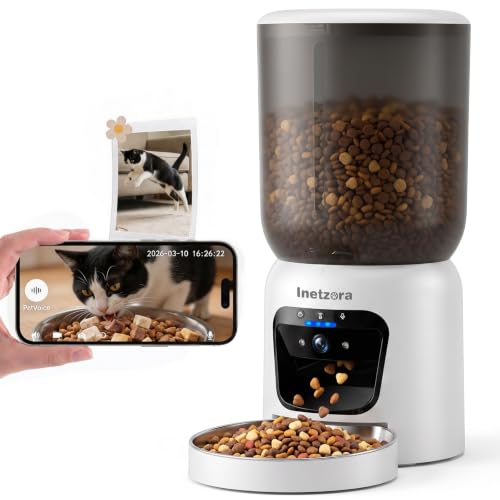
3. Inetzora Automatic Cat Feeder: best for camera and voice features on a budget
The Inetzora Automatic Cat Feeder sits between simple timers and fuller smart systems. It includes a 2K camera, two-way audio and a 6-liter container. Its price is lower than the Frienhund and PETLIBRO, which may appeal to buyers who want video features without a high cost.
What it does day to day
The feeder supports up to 10 meals per day, with 1 to 15 portions per meal. An app lets owners program the schedule and check feeding history. The camera allows owners to see how much food remains in the stainless steel bowl.
Key features in plain words
The camera is described as a 3 MP Full HD unit with infrared night vision. It supports photos and video, and cloud storage is available. The product listing notes that cloud storage includes a one-month free trial, with a subscription required afterward. Owners should review those terms before relying on cloud footage.
The Pet Voice feature includes built-in animal sounds and the option to record your own voice. This can help owners call a pet or check in during the day. The WiFi supports 2.4GHz and 5GHz networks, which can simplify setup on a home router.
Ease of use and performance
Setup centers on the app, and a stable home network makes the camera feed run more smoothly. The feeding and camera controls are easy to find for most users. The transparent 360-degree hopper helps owners see food levels at a glance.
Value for money
For buyers who want a camera and voice features at a lower price, the Inetzora offers a practical mix. The 6-liter container gives a useful amount of storage for weeks of meals, depending on the pet. Owners who need a longer warranty or support history may want to read more before buying, since those details are not in the data provided.
Pros
- Affordable price for a unit with a 2K camera and app control.
- Pet Voice feature includes sounds and custom voice recordings.
- Dual-band WiFi supports both 2.4GHz and 5GHz networks.
- Transparent hopper and stainless steel bowl make food levels easy to see.
Cons
- Cloud storage needs a paid subscription after the free trial.
- The 10-meal limit is lower than some rivals in this group.
- Camera quality and app details should be reviewed before purchase.
4. Automatic Cat Feeder by Yuposl: best for simple timing without WiFi
The Automatic Cat Feeder from Yuposl takes a different approach. It needs no WiFi or smartphone, because setup happens on an LCD screen with buttons. It is a good fit for owners who want a basic timer that works without an app.
What it does day to day
The feeder supports 1 to 6 meals per day, with portions that can be customized. Its 3-liter tank is listed as holding 12 cups. The product notes that the supply may last up to about two weeks, though this depends on the pet’s size and eating habits.
Key features in plain words
The feeder accepts dry food pieces from 2 to 15 millimeters. The design aims to prevent jams, including with larger kibble such as dental diets. A soft rubber rotor and a spring-lock lid help seal the food outlet between meals.
Power comes from three D-size alkaline batteries, which are not included, or from a wall supply. The listing gives battery life of more than 180 days. The stainless steel bowl is listed as dishwasher safe.
Ease of use and performance
Because there is no app, setup is direct. Owners press buttons and read the LCD screen to set times and portions. This keeps the process simple for beginners who prefer not to manage phone settings.
The feeder is also designed for households with more than one pet. Several units can be placed apart so that cats eat separately. This may help reduce competition at mealtime.
Value for money
At the lowest price in this group, the Yuposl feeder offers timed meals and a sealed design without a camera or WiFi. Buyers who need only scheduling may find this a sensible choice. Those who want monitoring or remote control will need a higher-priced model.
Pros
- Works without WiFi or a smartphone app.
- Anti-jam design handles larger kibble sizes.
- Stainless steel bowl is listed as dishwasher safe.
- Lowest price among the five products reviewed here.
Cons
- No camera or remote monitoring of the pet.
- Batteries are not included, so buyers must supply them.
- The 3-liter tank is the smallest in this group.
5. Smart Automatic Cat Feeder by Pitpet: best for a simple display and reliable backup power
The Smart Automatic Cat Feeder from Pitpet focuses on easy setup and dependable feeding. It has a 6-liter container, an LCD display and a dual power supply. It does not include a camera, so it suits owners who want a straightforward timed feeder.
What it does day to day
The feeder can dispense up to nine portions per meal, with six daily meals. The listing states that the container holds enough food for about 35 days for a cat and 20 days for a small dog. The feeder releases a preset amount at each meal, which helps owners keep portions consistent.
Key features in plain words
The LCD screen and included instructions guide setup. A recorded message of up to 10 seconds can call the pet at feeding time. The top of the feeder locks, and the base is non-slip, with extra stickers provided for stability.
The fe eder has a dual power supply and a memory setting, so it can resume feeding after a power outage, according to the listing. The bowl is dishwasher safe. The kibble stays in a sealed desiccant bag to help keep it fresh.
Ease of use and reliability
The controls are designed to be simple, so most owners can set a schedule without reading a long manual. The locking top and non-slip base help the unit stay put when a pet tries to tip it or reach inside.
The manual button also lets owners add a treat when needed.
The memory setting matters in homes where power cuts happen. Because the feeder can keep its schedule through an outage, meals are less likely to be missed. Owners should still check the batteries if they rely on that backup.
Value for money
The Pitpet sits in the middle of the price range. It offers a large 6-liter container, a clear display and backup power, but no camera or app control. For owners who want reliable timed meals without extra features, this balance can make good sense.
Pros
- Large 6-liter container holds weeks of food.
- Simple LCD display makes setup straightforward.
- Dual power supply and memory setting help during outages.
- Locking top and non-slip base limit tipping and paw access.
Cons
- No camera or remote app control.
- Only nine portions per meal, which may limit very fine splitting.
- Owners must check that the bowl and parts fit their cleaning routine.
Comparison insights: how the five feeders differ
The five feeders share the same basic job, but they vary in three main areas. Performance depends on tank size, meal count and if the device can report problems. Ease of use depends on if setup uses an app, a screen or buttons alone. Value depends on how many extra features, such as a camera, the buyer actually needs.
On capacity, the Frienhund holds 7 liters, the Pitpet 6 liters, the Inetzora 6 liters, the PETLIBRO 5 liters and the Yuposl 3 liters. Larger tanks mean fewer refills, which suits owners who travel often. Smaller tanks may suit single cats that eat less.
On control, the Frienhund, PETLIBRO and Inetzora rely on smartphone apps and WiFi. The Yuposl works with buttons and a screen only. The Pitpet uses an LCD display for setup. Owners who prefer no app will find the Yuposl or Pitpet easier to start with.
On monitoring, only the Frienhund and Inetzora include a camera with night vision and two-way audio. The PETLIBRO focuses on meal calls and alerts instead. Buyers who want to check on a pet remotely should look at the first two models.
On value, the Yuposl has the lowest listed price and the Frienhund the highest. The Inetzora offers camera features at a lower price than the Frienhund. Cost alone does not decide the best choice, since the right feeder depends on the features that matter to the owner.
Buying guide: key factors explained in plain words
Before picking a feeder, it helps to know which features matter most. The list below explains the main factors in everyday terms. Each one can change how well a feeder fits a household.
Tank capacity and refill needs
Tank size controls how often you must refill the feeder. A larger tank lasts longer between refills, which helps during trips or busy weeks. Check how many days the tank is expected to last for your pet’s size and eating habits.
Meal count and portion control
Some feeders offer only a few meals per day, while others allow ten or more. Portion options vary too. Owners who feed small, frequent meals may want more meal slots and finer portions.
WiFi, apps and remote control
A WiFi feeder can be managed from a phone, so you can change schedules from anywhere. Look for support for 2.4GHz and 5GHz networks if your router uses both. Without WiFi, you must set everything on the device itself.
Cameras and night vision
A camera lets you see your pet and check food levels. Night vision helps with with low-light viewing, which matters if your pet eats in a dim room. Cloud storage and microSD saving may carry extra costs or setup steps, so check those terms first.
Freshness and food protection
Dry food can lose its crunch and flavor when air and moisture get in. Sealed lids, rotors and desiccant bags help slow this process. A stainless steel bowl is often easier to clean and may suit pets sensitive to plastic.
Power backup and reliability
Some feeders run on batteries, a wall plug or both. Battery power keeps the feeder working during a cut in electricity, but batteries must be bought and checked. A memory setting can help the schedule continue after an outage.
Cleaning and daily care
Look for parts that come apart easily and can be washed. Dishwasher-safe bowls save time. A transparent tank makes it simpler to see how much food is left.
Who should buy these products: matching buyers to a feeder
Each feeder suits a different type of owner. The matches below are based on the listed features, not on personal testing. Use them as a starting point rather than a rule.
Owners who want to watch their pet eat and check food levels from a distance may prefer the Frienhund. Its camera, large tank and dual-band WiFi suit people who travel or work long hours. Households with bigger cats or small dogs may also find the 7-liter tank helpful.
Owners who want detailed portion and meal control may prefer the PETLIBRO. Its many meal slots and meal call recordings suit people who like to shape a precise feeding plan. Those who do not need a camera may find this focus a good fit.
Budget-minded buyers who still want a camera and voice features may consider the Inetzora. Its app, Pet Voice feature and 6-liter tank offer a practical mix. Owners should review the cloud storage terms before buying.
Buyers who want a basic timer without WiFi or an app may prefer the Yuposl. Its button and screen setup is simple, and its low price suits a first feeder. Households with two or more cats may also find its placement flexibility useful.
Owners who want a large tank, simple setup and backup power may consider the Pitpet. Its locking top and non-slip base suit pets that try to tip or reach into feeders. Those who need remote monitoring should look elsewhere.
Final verdict: which feeder should you choose?
No single feeder is the best choice for everyone. The right model depends on if you need a camera, app control, meal flexibility or a simple timer. Each product in this round-up offers a clear set of trade-offs.
For remote monitoring and a large tank, the Frienhund stands out in this group. For detailed meal control, the PETLIBRO is a strong option. For camera features at a lower price, the Inetzora is worth a close look. For simple timed meals without WiFi, the Yuposl is the most basic choice. For a large tank with backup power and easy setup, the Pitpet suits many households.
Before you buy, check the current listing for price, warranty and return terms. Confirm that the tank size and power needs fit your home. A careful match to your daily routine will matter more than any single feature.
Frequently Asked Questions
Do automatic pet feeders need WiFi?
Not always. WiFi feeders can be managed from a phone app, while models without WiFi are set with buttons and a screen. Choose WiFi if you want to change schedules or check on your pet remotely.
Can a feeder keep food fresh?
Most feeders use sealed lids, rotors and desiccant bags to slow moisture and air exposure. These features help dry food stay crisp for longer. Still, it is wise to clean the tank and bowl regularly.
Is a camera necessary for an automatic feeder?
No. A camera is useful if you want to watch your pet eat or check food levels, but timed feeders work well without one. Consider how often you would actually use the camera before paying extra for it.
How long does a full tank last?
It depends on the tank size, your pet’s size and how much it eats. Some listings give estimates, but these vary with the pet. Check the expected
How long does a full tank last?
It depends on the tank size, your pet’s size and how much it eats. Some listings give estimates, but these vary with the pet. Check the expected portion size against your pet’s daily needs before relying on any estimate.
Are these feeders safe for dogs?
Some models are described for cats, while others mention small or medium dogs. Feeders can work for dogs when the portion size and kibble fit the pet. Always confirm the product’s listed pet types and check with a vet about feeding plans.
What should I do if the feeder jams?
Start by checking the food outlet and removing any blocked pieces. Some feeders use sensors or indicator lights to warn about jams. Clean the parts regularly, since dust and crumbs are common causes of blockages.
In short
Each of these five feeders serves a different owner. The best choice depends on if you need a camera, app control, meal flexibility or simple timed feeding. Review the listed features, check the terms, and match the model to your daily routine.
Hi, I’m Mary, the founder of PetGadgetPro.com. I’m a passionate pet lover with a special place in my heart for dogs and cats. I share practical advice and honest insights on pet gear to help pet parents make better choices. My dedicated research team studies products in depth, and our writers create reviews using trusted, authentic sources—so you can feel confident choosing the best for your pets.