
How to Tell If a Cat Is Feral?
You see a cat lurking in the shadows near your garage. It looks different from the house cats you know. The way it moves, the way it watches you—everything feels wild and untamed. But is it truly a feral cat, or is it just a shy pet who got lost?
This question matters more than you might think. A feral cat needs different help than a stray or lost pet cat. Knowing the difference can change how you interact with the animal and what options are available to help it.
Let me walk you through the signs that tell you if a cat is actually feral. By the end, you’ll be confident in spotting the difference between a feral cat, a stray cat, and a lost house pet.
What Exactly Is a Feral Cat?
Before we talk about how to spot one, let’s define what we’re actually looking for.
A feral cat is a cat that was never socialized to humans. Most likely, it was born in the wild to a wild mother. It doesn’t have a home. It doesn’t have an owner. It survives completely on its own, relying on hunting or scavenging for food.
This is very different from a stray cat. A stray cat used to live with humans. It had an owner. It lived in a home. At some point, it got lost or was abandoned. That’s why a stray cat often responds better to humans. It remembers what people are like.
The key difference comes down to one thing: socialization. A feral cat was never exposed to human touch or care during its critical early weeks of life. That window closes fast, usually by the time a kitten is 12 to 14 weeks old. Miss that window, and you have a feral cat.
This matters because feral cats behave completely differently than strays. They’re wary. They’re skittish. They avoid humans at all costs.
The Body Language of a Feral Cat
Your best clue starts with how the cat carries itself. Body language speaks volumes.
The Tail
Look at the tail first. A feral cat holds its tail low or tucked between its back legs. The tail looks stiff and tense. It rarely waves it around freely like a friendly house cat does.
A socialized or stray cat often holds its tail high and relaxed. The tip might curl up slightly. It moves the tail in loose, flowing waves. A feral cat’s tail seems frozen, locked in place by fear or caution.
The Ears
Check the position of the ears. A feral cat’s ears often point backward or flatten completely against the head. The cat looks like it’s always braced for danger.
When a feral cat is very scared, the ears actually turn sideways. They look like airplane wings pointing out from the sides of the head. This is called “airplane ears” and it’s a dead giveaway that the cat is in serious defensive mode.
A friendly house cat’s ears point up and rotate toward sounds. The ears look relaxed and natural, not pinned back in fear.
The Face and Eyes
A feral wild cat looks tense in the face. The expression is hard and alert. The eyes are wide and watchful. The cat seems to be calculating whether you’re a threat or an escape route.
You’ll notice the cat’s mouth might be slightly open or tense. The whiskers often point backward rather than forward.
A house cat or stray cat usually has a softer face. The expression looks calmer. The eyes focus on you with curiosity rather than pure fear and suspicion.
Crouching and Posture
A feral cat crouches low to the ground. It makes itself small. The body language says “I’m ready to bolt at any second.”
This is different from a playful house cat that stretches out and relaxes around people. A feral cat never looks truly at ease when humans are around.
Distance and Behavior Around Humans
A feral cat’s relationship with distance is telling.
A feral cat will not let you get close. The moment it senses you’re too near, it runs. There’s no hesitation, no lingering, no attempt to communicate. It simply flees.
The safe distance for a feral cat is usually at least 30 feet away. Some feral cats stay even farther away than that. If you approach, the cat will move farther back. If you keep approaching, it will sprint away.
This is not like a nervous stray cat. A stray cat might be skittish, but it often comes closer to humans, especially if food is involved. A stray cat might meow. It might rub against your leg if it gets used to you over time. A stray cat is scared, but it’s also curious about humans.
A feral cat is never curious about you as a person. You are simply an obstacle or a threat to be avoided.
How a Feral Cat Acts When Cornered
Sometimes you get stuck in a situation where a feral cat can’t escape. Maybe it’s trapped in a shed or stuck behind a parked car.
In this case, a feral cat shows its true colors fast.
A feral cat won’t try to negotiate with you by meowing or rubbing. Instead, it goes into full defensive mode. You’ll see:
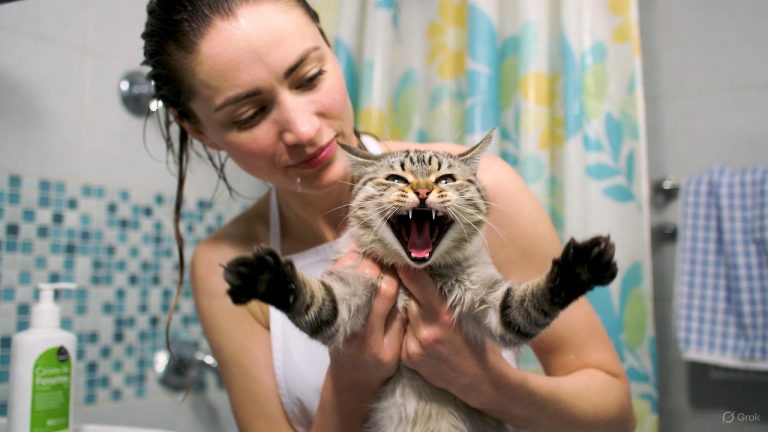
- Hissing and spitting: This is the cat’s warning system. It’s saying “stay back or else.” The hissing is loud, intense, and prolonged. It’s not a quick sound—it’s a sustained threat.
- Growling: You might hear a deep, guttural growl. This is an angry sound. It’s more aggressive than any noise a scared stray would make.
- Swatting and scratching: If the feral cat is truly trapped, it will fight. It swats with claws out. It scratches hard and fast. This isn’t defensive swatting—it’s aggressive combat.
- Attacking: In rare cases where a feral cat feels absolutely cornered with no way out, it might actually attack. It won’t run at you from a distance, but if you try to grab it or get too close to its face, it will fight back brutally.
A house cat or stray cat that feels cornered will also show fear, but the response is different. They’re more likely to try to hide or squeeze through small spaces. They’ll hiss, but the hissing is shorter and more hesitant. They want an escape route, not a fight.
Feral Cats and Vocalizations
Feral cats talk differently than house cats.
A feral cat rarely meows. This might surprise you. House cats meow at humans because they learned that meowing gets our attention and gets them what they want. But a feral cat never learned that lesson. It has no reason to meow at you.
Instead, a feral cat makes sounds for other cats. You might hear:
- Intense yowling: This is a long, drawn-out sound that other cats can hear from far away. Feral cats yowl to communicate with each other or to warn others to stay away from their territory.
- Hissing and spitting: As mentioned before, this is the main warning sound a feral cat uses around humans.
- Growling: Low and threatening.
- Chattering or clicking: Some feral cats make these sounds when they’re excited about prey or agitated.
If you hear a cat meowing at you, especially if it’s trying to get your attention, that’s actually a sign the cat is not feral. It learned that meowing works with humans. A feral cat doesn’t make that connection.
Physical Appearance and Condition
Now let’s talk about what a feral cat looks like.
Fur Condition
Feral cats often have rough, matted fur. The coat doesn’t look as shiny or well-groomed as a house cat’s fur. That’s because no one is brushing them, petting them, or caring for their grooming needs.
However, this isn’t always reliable. Some feral cats have relatively neat coats, especially in warmer climates where they spend more time grooming themselves. And some stray cats that have been on the streets for a while also have rough fur.
Still, overall coat condition can give you a clue. If the cat looks actively neglected and matted, it’s more likely to be feral or long-term stray.
Build and Weight
Feral cats are usually leaner than house cats. They’re muscular from constant hunting and surviving. Their bodies look streamlined and efficient.
House cats often have a softer, rounder appearance because they don’t need to hunt as hard. Stray cats might also be lean, but they’re often not quite as muscular as true feral cats.
Claws
Feral cats have longer, sharper claws because they use them constantly for hunting and climbing. House cats that live indoors have softer, duller claws because they’re trimmed or worn down from less demanding activities.
Ears and Face Markings
Check the ears closely. Many feral cat colonies have cats with torn or notched ears. These notches are actually intentional marks made by animal welfare organizations to indicate that the cat has been trapped and neutered as part of a TNR program (trap-neuter-return). If you see a notch in the ear, the cat has likely been cared for at some point.
But not all feral cats have ear notches. Some have torn ears from fights with other cats or rough living conditions.
Age Markers to Consider
A very young kitten can be feral, but there’s an important detail: young feral kittens can often be socialized if you catch them early enough, usually before they’re 8 to 12 weeks old.
How do you tell the age?
- Very young kittens (2-4 weeks) are small, wobbly, and often still dependent on their mother. They have tiny ears that look too big for their head.
- Kittens (4-8 weeks) are more coordinated but still small. They play and explore more actively.
- Older kittens (8-14 weeks) are more cat-sized, with longer legs and a more adult appearance.
- Juvenile cats (4-6 months) are almost full-sized but still lanky and playful-looking.
- Adult cats (1 year and older) have the muscular, alert appearance we’ve been discussing.
Age matters for intervention. A young feral kitten less than 8 weeks old might be savable through socialization. An adult feral cat is almost impossible to tame.
Signs Your Cat Is Actually a Stray or Lost Pet
Let me be clear about what’s NOT a sign of a feral cat.
The Cat Meows at You
If a cat meows, it learned to meow at humans. Feral cats don’t do this. So if a cat is meowing, it’s not fully feral.
The Cat Responds to Your Voice
If a cat reacts to your voice, looks at you when you call, or shows any sign it understands human communication, it has been around humans. A feral cat ignores human voices entirely.
The Cat Approaches You for Food
A truly feral cat will not come close enough to eat from your hand, even if you’re offering the most amazing food. A stray cat will. It might be wary, but it will come closer.
If a cat eats food you put down, it’s not feral. It’s adjusted enough to humans to understand food is a resource worth getting near.
The Cat Shows Any Interest in Human Objects
Feral cats don’t play with toys. They don’t rub against furniture. They don’t investigate human things. If you see a cat playing with a ball or rubbing its face on a fence post, it’s had human contact.
The Cat Allows Touch, Even Briefly
If you can touch the cat at all, even if it runs away immediately after, it’s not fully feral. It might be a young stray or a feral cat that had some early exposure to humans. But a true feral cat won’t let you touch it. Ever.
What to Do If You Find a Feral Cat
Now that you know how to identify one, what should you actually do?
Never Try to Catch It
A feral cat will hurt you if cornered. Their claws are sharp, their motivation is strong, and they’re driven purely by fear and survival instinct. You will not “win” this fight. Leave the cat alone.
Contact Local Rescue Organizations
If the feral cat seems sick, injured, or stuck, call your local animal rescue. They have people trained in handling feral cats. They have equipment. They know how to help safely.
Support TNR Programs
TNR stands for Trap-Neuter-Return. These programs catch feral cats, sterilize them, give them medical care, and return them to their outdoor territory. This helps control the feral cat population humanely.
If you see feral cats in your area, look up TNR programs near you. These groups do amazing work.
Provide Food and Water if You Want to Help
If you want to support feral cats in your area without interfering with them, put out food and water from a distance. Use feeding stations that keep the food contained. This helps the cats survive without you trying to tame them.
Never Assume You Can Tame a Feral Cat
Some people think they can befriend a feral cat through patience and kindness. This rarely works with adult feral cats. A cat that was never socialized during the critical early weeks will remain wary of humans for its entire life.
This doesn’t mean the cat is bad or broken. It just means the cat is wild, and wildness is not a personality flaw. It’s a fact of life for that cat.
The Difference Between Feral, Stray, and Lost Cats
Let’s put all this together with a quick comparison.
A Feral Cat:
- Never meows at humans
- Avoids humans at all costs with a distance of 30+ feet
- Has a tense, alert body posture
- Ears pinned back or sideways
- Tail low or tucked
- Hisses, spits, or growls if approached
- Won’t come for food you offer
- Has a rough coat and lean build
- Was never socialized to humans
- Cannot be tamed as an adult
A Stray Cat:
- Might meow at you
- Approaches humans, especially for food
- Shows curiosity along with caution
- Body language is nervous but not purely defensive
- Will eat food you offer
- Might eventually allow petting or touch
- Often looks like a typical house cat
- Was socialized to humans at some point
- Can often be rehomed with patience
A Lost House Cat:
- Meows at you, often frantically
- Seeks human interaction and help
- Shows affection or at least willingness to be touched
- Approaches you directly without extreme fear
- Might be wearing a collar or have an ID
- Looks well-fed and groomed
- Shows signs of dependence on humans
- Usually tries to communicate what it needs
- Can be returned to its owner
Why This All Matters
Understanding the difference between a feral cat and other types of cats matters for several reasons.
First, it affects how you should respond. Trying to capture a feral cat by yourself can result in serious injuries. Knowing it’s feral stops you from making that mistake.
Second, it helps you get the right help. A stray cat needs to be trapped and brought to a shelter to find its owner or get rehomed. A feral cat needs TNR support, not shelter placement.
Third, it helps you understand the cat’s needs. A feral cat isn’t unfriendly because it’s traumatized. It’s unfriendly because it was never taught to be friendly. That’s not sad—it’s just the reality of a wild animal.
Finally, it helps you make good decisions about your own safety and the safety of other animals. Feral cats don’t belong indoors. They can’t adjust. They’ll bite, scratch, and escape at the first opportunity.
Signs to Watch for Over Time
If you’re observing a cat for a while and trying to figure out what type it is, watch for these patterns.
Feral cats:
- Never get closer to you no matter how much time passes
- Never change their defensive behavior
- Consistently avoid all human contact
- Hunt actively and live wild
- Interact with other cats but avoid humans entirely
Stray cats:
- Gradually get closer over time as they realize you’re not a threat
- Reduce their defensive behavior with repeated positive interactions
- Eventually allow touch or petting
- Show increased interest in human presence
- Often seek out human company
This time-based observation can help you distinguish between a very fearful stray and a true feral.
Common Myths About Feral Cats
Let me clear up some confusion.
Myth: Feral cats are mean or aggressive.
No. Feral cats are wild. They’re not aggressive—they’re defensive. They attack humans only when cornered or felt threatened. They’re not interested in hurting people. They’re interested in survival.
Myth: All outdoor cats are feral.
No. Many outdoor cats are strays or pets whose owners let them roam. These cats have human socialization. Feral cats are specifically those with zero socialization to humans.
Myth: Feral kittens are the same as feral cats.
Young kittens (under 8 weeks) can sometimes be socialized if caught early. Adult feral cats cannot.
Myth: Feral cats can’t live decent lives.
Feral cats that are part of a TNR program and a stable colony often live reasonably well. They hunt, they socialize with other cats, they survive. It’s not the life of a house cat, but it works for them.
Myth: You should never feed feral cats.
Some people disagree on this, but feeding feral cats is actually helpful, especially in winter or when natural food sources are scarce. Just maintain distance and use proper feeding stations.
Final Thoughts
Learning to identify a feral cat is a valuable skill. It shapes how you interact with the animal and what kind of help you offer.
The key is to watch the body language, observe the distance the cat keeps, and listen for vocalizations. A feral cat will show itself through its behavior. You don’t need to get close. Just watch and observe.
If you ever encounter what you believe is a feral cat, keep your distance, stay safe, and contact local animal rescue if the cat seems to need help. That’s the safest, kindest approach for everyone involved.
The world has room for both house cats and feral cats. Understanding which one you’re looking at just means you’ll handle the situation the right way.

Hi, I’m Mary, the founder of PetGadgetPro.com. I’m a passionate pet lover with a special place in my heart for dogs and cats. I share practical advice and honest insights on pet gear to help pet parents make better choices. My dedicated research team studies products in depth, and our writers create reviews using trusted, authentic sources—so you can feel confident choosing the best for your pets.