5 Best Collar for Reactive Dog In 2026
If you have a reactive dog, you already know the stress. One squirrel on the sidewalk, one passing bike, one unfamiliar dog across the street — and suddenly your arm feels like it’s being yanked out of its socket. Walks feel like a battlefield. And you’re probably wondering if there’s a collar out there that can actually help.
The good news? There is. The right collar can make a massive difference in how you manage and train a reactive dog. It gives you more control, helps you redirect attention, and supports your training efforts without causing harm to your dog.
But here’s the tricky part — not every collar works the same way. Some are great for mild reactivity. Others are better for strong pullers. Some need more skill to use safely. Pick the wrong one, and you could make things worse.
That’s exactly why this guide exists. We’ve rounded up five of the most popular and well-regarded collars used for reactive dog training. We’ll break each one down in plain English — what it is, how it works, who it’s best for, and what real-life use looks like. No fluff. No fake glowing reviews. Just honest, useful information so you can make a smart choice.
Quick Overview: The 5 Collars We’re Reviewing
Here’s a fast snapshot before we dive deep:
- Mayerzon No Pull Dog Collar — A patented martingale-style collar with a buckle. Great for mild to moderate reactivity.
- Starmark Pro-Training Dog Collar — A plastic link collar that delivers consistent, gentle pressure. Good for training without metal.
- Generic Prong Collar with Quick Release Buckle — A basic but functional pinch collar that comes with extra links. Affordable and adjustable.
- Herm Sprenger Ultra-Plus Chrome Prong Collar — A premium German-made prong collar. Widely considered the gold standard in prong collar design.
- Rotating Ring Prong Training Collar — A pinch collar with a rotating ring design and quick-release buckle. A solid mid-range option.
Each one has its place. Each one has its limits. Let’s look at all five.
Product Reviews
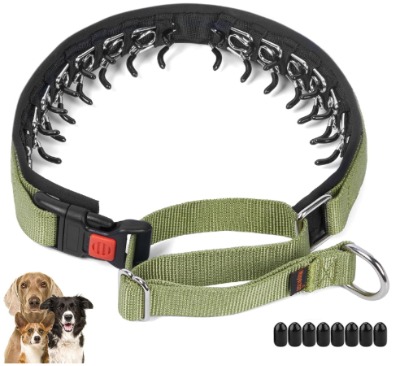
1. Mayerzon No Pull Dog Collar — Patented Martingale Collar with Buckle
What It Is
The Mayerzon collar is a martingale-style dog collar built from heavy-duty nylon. It comes with a buckle for easy on and off, which is one of the main things that sets it apart from traditional slip-style martingale collars. The design is simple but clever — it tightens slightly when the dog pulls, then loosens again when tension releases.
It’s available in multiple sizes and comes in colors like green. The medium size is a popular choice for mid-sized dogs between roughly 35 and 65 pounds.
How It Works
The martingale mechanism uses two loops. The larger loop goes around the dog’s neck. The smaller loop — called the control loop — connects to the leash. When the dog pulls, the smaller loop tightens the larger loop, applying even pressure around the neck. It doesn’t choke the dog the way a regular slip collar can because the tightening has a built-in limit.
This “limited slip” action is what makes martingale collars so popular for reactive dogs. It discourages pulling without the sharp, sudden corrections that metal prong collars deliver.
The buckle design is a genuine convenience feature. You don’t have to slip the collar over the dog’s head every time. That matters a lot if your dog gets excited and wiggly during gear-up time — which reactive dogs often do.
Best Use Cases
- Dogs with narrow heads who slip out of regular flat collars (like Greyhounds, Whippets, and similar breeds)
- Dogs with mild to moderate reactivity who need gentle feedback during walks
- Owners who want a non-metal, more socially acceptable training tool
- Training contexts that involve recall, leash manners, and basic obedience
Key Features Explained Simply
Patented martingale design: The collar tightens under tension and releases when the dog relaxes. It’s a smooth, even pressure — not a sharp pinch or a jerk.
Buckle closure: Makes putting the collar on and taking it off fast and easy. No struggling to get the collar over your dog’s head while they’re spinning in excitement.
Heavy-duty nylon: The material is tough, weather-resistant, and holds up well to regular outdoor use. It doesn’t fray easily and resists getting soaked and stretched out.
Adjustable fit: The sizing system lets you dial in a snug but comfortable fit for your specific dog’s neck.
Real-Life Usage Insight
This collar works well for dogs who are reactive but not dangerously strong. On a moderate walk with a 50-pound dog who lunges at passing joggers, the martingale action gives a consistent signal that something is happening — but it’s not a harsh correction. The buckle makes the pre-walk ritual much smoother, especially when the dog is already amped up before even leaving the house.
It’s not a miracle fix. A highly reactive, high-drive dog who throws themselves at fences is going to need something with more bite. But for dogs who react out of anxiety or excitement and need a gentle reminder, this collar handles that job well.
One thing owners notice quickly: the nylon can sometimes dig a bit into longer-coated dogs if the collar sits in one spot for a long time. Rotating its position slightly helps.
Pros
- Gentle, even pressure — no sharp corrections
- Buckle makes it fast and easy to put on and take off
- Durable nylon that holds up in all weather
- More comfortable than metal slip collars
- Works well with positive reinforcement training methods
- Good option for nervous or anxious reactive dogs
- Available in multiple sizes for different breeds
Cons
- Not strong enough for highly reactive or hard-pulling large dogs
- May not provide enough feedback for dogs with high pain tolerance
- Nylon can irritate the coat of long-haired breeds with repeated friction
- Not ideal as a stand-alone tool for severe reactivity without training support
Performance
For what it’s designed to do, the Mayerzon martingale collar performs reliably. The tightening mechanism is smooth and consistent, and it releases quickly. The buckle adds convenience without compromising the martingale action. It’s not a high-intensity training tool — it’s a management and communication device for dogs who need a soft, consistent signal.
Ease of Use
Very easy. The buckle removes almost all fumbling during setup. The collar adjusts with a simple slider. You clip the leash to the control loop and you’re ready. Almost anyone can figure this out without instructions.
Value for Money
Very good. Martingale collars are affordable in general, and the Mayerzon adds a buckle that many similarly-priced options don’t include. For a mild reactivity tool with everyday walk use, it gives you solid value.
2. Starmark Pro-Training Dog Collar (Large)
What It Is
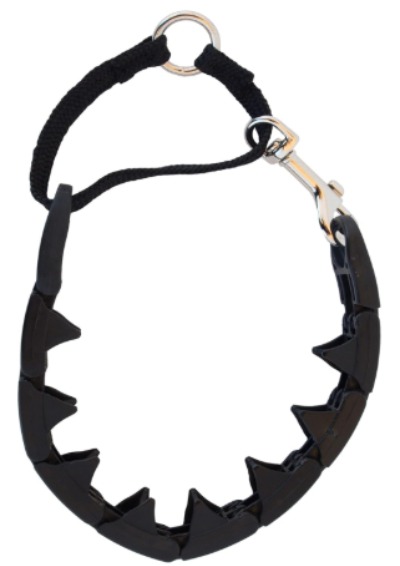
The Starmark Pro-Training Dog Collar is a plastic interlocking link collar designed to deliver consistent, even pressure around the neck during training. It looks a little like a plastic version of a prong collar, but it functions differently. The links lock together and release based on leash tension, delivering a “tap” sensation rather than a sharp pinch.
It was developed specifically as a training tool for dogs who need more feedback than a flat collar provides but whose owners prefer to avoid metal hardware.
How It Works
The collar is made up of interconnected plastic links that sit against the dog’s neck. When the leash goes taut, the links press inward in a uniform, circular motion — similar in theory to a martingale but with more distributed contact points. When the tension releases, the links relax and the collar loosens.
The key difference from a martingale is the multi-point contact. Instead of a band of nylon pressing against the neck, you get multiple small contact points from the plastic links. This is thought to be more noticeable to the dog without being painful.
It comes in a large size, designed for dogs with neck sizes in the 18″ to 26″ range.
Best Use Cases
- Medium to large reactive dogs who need more collar feedback than a flat collar
- Owners who want a training collar without metal prongs
- Dogs in ongoing obedience or behavior modification training
- Handlers who prefer a visual alternative to metal prong collars
Key Features Explained Simply
Plastic interlocking links: These are the core of the collar’s design. They press evenly against the neck when tension is applied and release cleanly when it’s not. The plastic is firm but not as intense as metal prongs.
Consistent feedback: Because the links move together, the dog gets the same type of feedback every time — no sudden sharp jabs from a loose prong.
Easy link adjustment: You can add or remove links to get the right fit. The collar should fit snugly but not tight when resting.
Durable design: Starmark is a well-known brand in the training space. Their products are built for repeated daily use.
Real-Life Usage Insight
The Starmark collar tends to get good results with dogs who have learned to ignore flat collars entirely. For a 70-pound Labrador who blows through a regular collar the second a dog appears across the street, the Starmark provides a noticeable new sensation that the dog hasn’t learned to tune out yet.
Trainers often use this collar as a stepping stone — somewhere between a flat collar and a metal prong collar. Dogs who are reactive out of excitement (rather than pure fear) respond to it well in most cases.
The plastic material is also a practical advantage. On wet or snowy walks, a metal prong collar can get cold and uncomfortable. Plastic doesn’t have that problem.
One honest note: some very large, strong, or determined dogs find a way to barrel through the Starmark’s feedback. For those dogs, a stronger tool may be necessary.
Pros
- No metal — won’t rust, won’t get cold in winter
- Multi-point contact delivers even, consistent pressure
- Works well for dogs who’ve become desensitized to flat collars
- Adjustable link system for precise fit
- Trusted brand with a solid reputation in the training world
- Good stepping stone collar before moving to more advanced tools
- Effective with medium to large dogs in training programs
Cons
- Some very strong dogs can push through the feedback
- Plastic links can crack or break with extreme force over time
- Requires proper fit to function well — too loose and it’s ineffective
- Not appropriate for tiny breeds or very delicate dogs
- Does have a strong visual resemblance to a prong collar, which bothers some people
Performance
The Starmark delivers on its promise for most medium and large dogs. It provides meaningful feedback during reactive moments without the intensity of a metal prong. Results are best when paired with consistent training — the collar alone won’t fix reactivity, but as a communication tool it works well.
Ease of Use
Moderate. The link system requires a bit of learning to resize correctly, and getting a proper fit takes a few adjustments. Once set up, day-to-day use is simple. Attaching and detaching is clean and fast.
Value for Money
Good. The Starmark collar is priced in the mid-range for training collars. Given its durability and effectiveness, it holds up well against similarly priced options.
3. Generic Prong Collar for Dogs — Adjustable Dog Training Collar with Quick Release Buckle (Packed with Two Extra Links)
What It Is
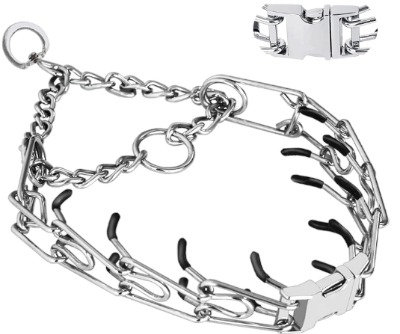
This is a standard steel prong collar (also called a pinch collar) that comes packaged with two extra links and a quick-release buckle for easy fitting and removal. It’s designed for small, medium, and large dogs and is adjustable by adding or removing links.
Prong collars are among the most polarizing tools in dog training. Used correctly and with proper knowledge, they can be effective communication tools. Used incorrectly, they can cause harm. This one falls in the entry-level category — functional, affordable, and widely available.
How It Works
Each link in the collar has inward-facing prongs. When the dog pulls on the leash, the collar tightens and the prongs press against the skin around the neck in a pinching motion. When the dog stops pulling, the tension releases and the collar loosens.
The sensation mimics — in a rough way — how a mother dog communicates with a puppy by gripping the scruff of the neck. The intent is to give the dog feedback they understand instinctively, rather than just pulling against a flat surface.
The quick-release buckle is a practical addition. Traditional prong collars require you to pull the links apart by hand to open and close them, which can be awkward. The buckle lets you put the collar on and take it off in seconds.
The included extra links mean you can fit a wider range of neck sizes right out of the box.
Best Use Cases
- Reactive dogs with a strong pull who’ve outgrown flat and martingale collars
- Dogs in intermediate to advanced training programs under professional guidance
- Handlers who have learned proper prong collar technique from a trainer
- Dogs who need clearer, sharper communication during reactive moments
Key Features Explained Simply
Steel prong links: The prongs sit against the neck and apply pressure when tension is applied. The spacing and angle of the prongs determines the level of intensity.
Quick-release buckle: Clips the collar on and off without having to disassemble the links. Makes fitting the collar faster and less stressful.
Adjustable size: Add or remove links to fit different neck sizes. The extra links included mean you don’t need to buy add-ons separately.
Adjustable fit for precise sizing: Proper fit is critical with prong collars. It should sit high on the neck just behind the ears, snug enough not to slide around.
Real-Life Usage Insight
For a strong, reactive dog who’s been blowing through every other collar for months, a prong collar can feel like a revelation. The feedback is sharp, immediate, and clear. Dogs that ignore martingale tightening or flat collar pressure will almost always respond to a prong collar’s signal.
That said, the entry-level build quality of this collar is noticeable. The steel isn’t the highest grade, the prongs may not be as well-polished as premium options, and the links can occasionally feel stiff to open and close. It works, but it doesn’t feel as solid as something like the Herm Sprenger.
Pairing it with professional guidance is strongly recommended. A prong collar used without knowledge of how to time corrections — or one that’s fitted too loosely so it slides around — can produce confusing signals or cause injury.
Pros
- Provides clear, sharp feedback for strong pullers
- Quick-release buckle makes daily use more convenient
- Comes with extra links for flexible sizing
- Works on small, medium, and large dogs
- Affordable entry point into prong collar training
- Immediate response from most reactive dogs
Cons
- Build quality is entry-level — not as refined as premium brands
- Prongs may not be as smooth or well-finished as higher-end options
- Can cause harm if used incorrectly or fitted improperly
- Requires knowledge and ideally professional guidance to use safely
- Not appropriate for reactive dogs whose reactivity is rooted in fear or anxiety
- Not recommended without pairing with consistent positive training
Performance
Functional for its price range. Dogs respond to it. The quick-release buckle works well. The overall build is adequate for everyday use, but this isn’t a collar you’d want to stress-test with an extremely powerful dog day after day. For occasional corrective use in a structured training program, it gets the job done.
Ease of Use
Moderate with the quick-release buckle. Without it, prong collars require more skill to put on and take off. The buckle lowers the bar significantly. Getting the fit right takes practice — first-timers are advised to work with a trainer to dial this in.
Value for Money
Good for the budget-conscious buyer. You get the basics — a functional prong collar with extra links and a buckle — at a low price. For someone just starting prong collar training under professional supervision, it’s a reasonable starting point.
4. Herm Sprenger Ultra-Plus Chrome Plated Steel Prong Dog Training Collar — 22in x 3.0mm (Medium, Made in Germany)
What It Is
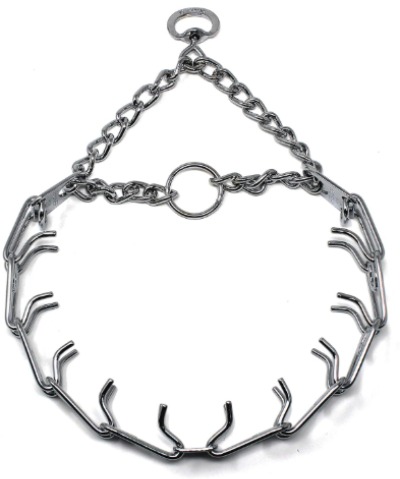
The Herm Sprenger prong collar is, by most accounts, the gold standard of prong collar design. Made in Germany by a company with over a century of experience in animal hardware, this collar is built to a level of precision and quality that entry-level prong collars simply can’t match.
The 3.0mm link size is designed for medium-sized dogs, fitting necks up to 18 inches. The ultra-plus chrome plating gives it a bright finish and protects against corrosion.
How It Works
It works on the same basic principle as other prong collars — inward-facing prongs apply pressure when the leash goes taut. But the Herm Sprenger differs in execution. The prongs are precision-machined to have blunt, rounded tips. They’re not sharp. The pressure they apply is meant to be surprising, not painful — a strong signal rather than a wound.
The links fit together with impressive smoothness. When the collar tightens, every prong moves in unison, applying completely even pressure all the way around the neck. When tension releases, the collar drops open cleanly and immediately.
This collar is designed to sit high on the neck, just behind the ears and below the jaw. In that position, it’s most communicative and least likely to cause any harm.
Best Use Cases
- Reactive dogs who need clear, precise leash communication
- Working dogs, sport dogs, and dogs in serious behavior modification programs
- Owners who have committed to learning correct prong collar technique
- Anyone who wants a lifetime-quality tool that won’t fail under daily pressure
Key Features Explained Simply
3.0mm ultra-plus chrome steel: The link thickness is right for medium dogs. Too thin and corrections feel too sharp. Too thick and the collar becomes heavy and slow to respond. 3.0mm is a well-regarded choice for dogs in the 30 to 65 pound range.
Rounded, blunt prong tips: This is one of the defining features. Cheap prong collars sometimes have rough or even sharp prong tips that can break the skin. Herm Sprenger prongs are smooth and blunt — they apply pressure but don’t puncture.
Precision link construction: Each link is machined to fit the next one with minimal play. The result is a collar that moves as one unit rather than a loose, jangling chain.
German manufacturing: Not just marketing. The quality control on Herm Sprenger products is consistently excellent. These collars don’t fail, bend, or corrode the way cheaper options can.
22-inch length fits necks up to 18 inches: This accounts for the overlap needed to seat the collar properly.
Real-Life Usage Insight
If there’s one collar that professional dog trainers and behaviorists reach for when working with reactive dogs, the Herm Sprenger is at or near the top of that list. The smoothness of the mechanism means corrections can be delivered with a light touch — a flick of the wrist rather than a full arm movement. For a reactive dog who launches themselves at a passing bicycle, that level of control is meaningful.
The rounded prongs are a big deal. On a cheaper collar, owners sometimes notice redness or hair loss around the neck after extended training sessions. With Herm Sprenger, that’s far less common when the collar is fitted and used correctly.
One thing to keep in mind: even the best prong collar in the world requires proper technique. You still need to know how to fit it correctly, position it properly, and time your corrections. If you haven’t worked with a prong collar before, investing in a session with a certified trainer before using this collar is time well spent.
Pros
- Best-in-class build quality and materials
- Rounded, blunt prong tips reduce risk of skin irritation
- Smooth, precise mechanism applies even pressure around the neck
- Made in Germany with rigorous quality standards
- Doesn’t rust, bend, or break under regular use
- Clear, effective communication for reactive dogs
- Trusted by professional trainers worldwide
- Long-lasting — may genuinely last the dog’s entire lifetime
Cons
- Significantly more expensive than entry-level prong collars
- Still requires proper training and technique to use safely
- Not appropriate for fearful or anxiety-reactive dogs
- Wrong size selection can undermine effectiveness — must be fitted correctly
- Social perception of prong collars can be a barrier in public settings
Performance
Exceptional. This collar does everything a prong collar is supposed to do, and it does it better than almost anything else on the market. The mechanism is smooth, the feedback is clear, and the build quality ensures it performs consistently day after day. For owners who’ve committed to prong collar training with professional guidance, this is the version to get.
Ease of Use
Moderate. Like all prong collars, the Herm Sprenger requires proper sizing, placement, and technique. The links are high quality and open and close smoothly, but you’ll still need to practice working with the link system for resizing. Many owners keep a dedicated fitted Herm Sprenger set for their dog so daily application is just a matter of snapping it in place.
Value for Money
High upfront cost, but exceptional long-term value. The Herm Sprenger outlasts multiple entry-level collars and performs more reliably. If you’re going to use a prong collar consistently, paying more for the best version makes sense.
5. Prong Training Collar for Dogs — Rotating Ring Welding, Adjustable Pinch Collar with Quick Release Buckle
What It Is
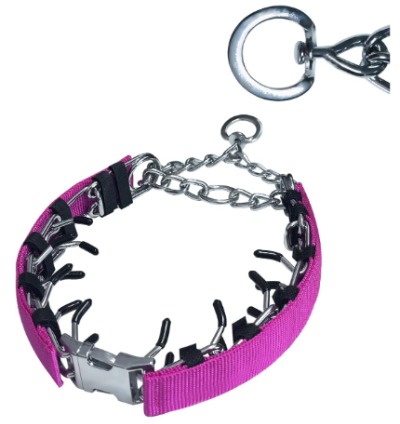
This is a prong collar that features a rotating ring welded directly into the collar structure, combined with a quick-release buckle for easy on and off. It’s adjustable via link addition and removal and is marketed for small, medium, and large dogs.
The rotating ring is the distinguishing feature here. Unlike fixed-ring prong collars where the leash attachment point stays in one spot, a rotating ring follows the movement of the leash, keeping the collar seated evenly on the neck as the dog and handler move.
How It Works
It works like a standard prong collar, with the prongs applying inward pressure when the leash is taut. The rotating ring adds a refinement — as the leash moves (say, from the left side to the right as a dog changes direction), the ring rotates to follow. This prevents the collar from being pulled askew, which keeps the prongs sitting evenly and the pressure consistent.
The quick-release buckle lets you put the collar on and remove it without splitting links apart, which is a practical daily-use improvement over collars without this feature.
Best Use Cases
- Reactive dogs with an active, erratic movement pattern who pull in multiple directions
- Handlers who want a prong collar with improved consistency of fit during dynamic movement
- Owners who’ve already had experience with prong collars and are looking for a step up in design
- Dogs who frequently change direction on walks or during training
Key Features Explained Simply
Rotating ring: The leash attachment point rotates freely, so it stays aligned with the direction of leash tension regardless of how the dog moves. This helps the collar sit evenly and apply consistent pressure.
Welded construction: The ring is welded into the collar structure rather than just crimped or pressed in. Welded connections are generally stronger and less likely to fail under repeated stress.
Quick-release buckle: Snaps the collar on and off fast. Great for reactive dogs who don’t love standing still while gear gets fiddled with.
Adjustable link system: Add or remove links to fit different neck sizes. Standard adjustability for a prong collar of this type.
Real-Life Usage Insight
The rotating ring is a feature that sounds subtle on paper but makes a real difference in practice. With a fixed-ring prong collar, a dog that spins or changes direction quickly can cause the collar to twist, which moves the prongs to an uneven position. When that happens, one side of the neck gets more pressure than the other — which is less fair and less effective. The rotating ring addresses that cleanly.
For an owner who walks a reactive, unpredictable dog that darts left, then right, then slams on the brakes at the sight of a cat — this collar tends to stay in position more reliably than a fixed-ring option.
The build quality sits between the entry-level generic collars and the Herm Sprenger. It’s noticeably more refined than the cheaper options, but it doesn’t quite match the German-made collar’s precision.
Pros
- Rotating ring improves collar consistency during dynamic movement
- Welded construction adds structural strength
- Quick-release buckle makes daily use convenient
- Works with small, medium, and large dogs
- More refined design than basic entry-level prong collars
- Good choice for active, unpredictable reactive dogs
Cons
- Not quite at Herm Sprenger quality level
- Still requires proper fit and handler knowledge to use safely
- Not for fearful reactive dogs — can worsen fear-based reactivity
- Rotating ring adds a small complexity point — check the weld periodically for wear
- More expensive than basic prong collars, less polished than premium options
Performance
Solid mid-range performance. The rotating ring does its job and the collar functions reliably for daily training use. It’s a meaningful improvement on basic prong collars for active dogs, and the quick-release buckle adds genuine convenience.
Ease of Use
Moderate. The quick-release buckle makes daily application easier. Resizing the link count requires the same process as any prong collar. The rotating ring is passive — it just does its job without any action required from the handler.
Value for Money
Good. Sits in the middle of the price range for prong collars. The rotating ring and welded build justify a small premium over basic options. For owners who’ve already committed to prong collar training, this is a smart, practical upgrade.
Comparison Insights: How Do These 5 Stack Up?
Let’s put them side by side across the key factors.
Feedback Intensity: Martingale (Mayerzon) → Starmark → Generic Prong → Rotating Ring Prong → Herm Sprenger
The martingale gives the gentlest signal. The Herm Sprenger, when used with precise technique, gives the clearest and most adjustable feedback.
Build Quality: Herm Sprenger is in a class of its own. The Starmark and rotating ring collar are both solid mid-tier options. The Mayerzon nylon collar is good for its category. The generic prong collar is functional but entry-level.
Ease of Use for Beginners: The Mayerzon martingale is the friendliest starting point. No training knowledge required. Starmark is a close second. All three prong collars require at least some instruction to use correctly.
Best for Mild Reactivity: Mayerzon Martingale
Best for Moderate Reactivity: Starmark Pro-Training
Best for Strong Pullers: Herm Sprenger or Rotating Ring Prong
Best Budget Option: Generic Prong Collar
Best Premium Option: Herm Sprenger
Buying Guide: What to Look For in the Best Collar for Reactive Dog
1. Know Your Dog’s Reactivity Level
Mild reactivity — a dog that alerts and stares but can be redirected easily — needs a gentler tool. A martingale or Starmark collar may be all you need. Severe reactivity — lunging, snarling, dragging you down the street — needs a collar with more stopping power.
2. Consider the Root of the Reactivity
This is one of the most important factors and gets overlooked constantly.
Is your dog reactive because of excitement? They pull toward things they want to investigate. A prong collar or martingale can work well here.
Is your dog reactive because of fear? They react to things that scare them. Using a prong collar on a fear-reactive dog can make the fear much worse — the dog learns to associate the painful sensation with the scary thing, which increases anxiety.
Fear-reactive dogs are generally better served by management tools (front-clip harnesses, gentle leaders, or soft martingales) combined with behavior modification training under a qualified trainer.
3. Match the Collar to the Dog’s Size and Strength
A small correction from a prong collar on a 20-pound dog is a very different thing than the same correction on a 100-pound dog. Make sure the collar weight, link size, and intensity are appropriate for your dog’s size.
4. Fit Is Everything
A loose prong collar is dangerous and ineffective. An improperly positioned martingale gives unclear feedback. Every collar on this list needs to be fitted correctly to work properly and safely.
With prong collars especially: they should sit high on the neck, just behind the ears. Not in the middle of the neck. Not hanging low near the shoulders.
5. Use a Tool as Part of a Training Program
No collar fixes reactivity by itself. The collar is a communication and management device. The actual work of reducing reactivity happens through consistent training, desensitization, and positive reinforcement.
Think of the collar as a tool that helps you communicate in the short term while the training does its long-term job.
6. Quick-Release Buckles Are Worth It
Any collar used on a reactive dog benefits from a quick-release buckle. Reactive dogs are often aroused and hard to keep still. A buckle makes the process faster and less stressful for both of you.
7. Budget Honestly
A cheap prong collar that breaks at the wrong moment is worse than no collar. If you’re going the prong collar route, it’s worth spending the money for quality — ideally a Herm Sprenger. If budget is a real constraint, the generic prong collar works, but inspect it regularly for wear.
Who Should Use These Products?
The Mayerzon Martingale is best for:
- First-time dog owners dealing with mild leash reactivity
- People who want a gentle, force-light approach
- Greyhound, Whippet, or sighthound owners
- Anyone uncomfortable with training collars that use stronger pressure
The Starmark Pro-Training Collar is best for:
- Owners who want more feedback than a flat collar without using metal
- Dogs in active training programs with a focus on leash manners
- Medium to large dogs who’ve outgrown flat collar usefulness
- People who want a plastic option for cold weather use
The Generic Prong Collar is best for:
- Budget-conscious owners who want to try prong collar training
- People working with a trainer who can help them fit and use it correctly
- Dogs with moderate to strong reactivity who need clear feedback
- Anyone who wants extra links included from the start
The Herm Sprenger Prong Collar is best for:
- Experienced dog owners or those working closely with a professional trainer
- Reactive dogs who need the clearest, most precise communication possible
- Anyone who wants a lifetime-quality tool built to the highest standard
- Working dog owners and serious sport dog handlers
The Rotating Ring Prong Collar is best for:
- Active, erratic reactive dogs who move unpredictably
- Owners who want a mid-range prong collar with a practical design upgrade
- Anyone already familiar with prong collar use looking for better consistency
Common Mistakes to Avoid
Using a Prong Collar Without Professional Guidance
This is the single biggest mistake reactive dog owners make. Prong collars are nuanced tools. Timing matters enormously. Fit matters enormously. Used wrong, they can hurt your dog physically and worsen reactivity behaviorally. If you’re new to prong collars, spend time with a certified trainer before using one on your own.
Choosing a Collar Based on Looks Alone
A collar that looks tough isn’t automatically effective. And a collar that looks gentle isn’t automatically the right choice for every dog. Match the tool to the dog’s specific needs.
Leaving a Training Collar on All Day
Prong collars and even martingale collars are training tools. They’re not meant to be worn 24/7. Remove them when walks or training sessions are done. Leaving a prong collar on unsupervised can lead to injury if it gets caught on something.
Skipping the Fit Check
Every time you put a training collar on your dog, take two seconds to check the fit. Prong collars especially can change fit as links wear or adjust over time. A loose collar is almost as useless as no collar, and potentially more dangerous.
Expecting the Collar to Do the Work
A collar controls pulling in the moment. It doesn’t address the emotional state driving the reactivity. If you’re not also working on the underlying behavior — through desensitization, counter-conditioning, and training — the reactivity will continue long-term.
Using a Strong Correction Collar on a Fear-Reactive Dog
Reactive behaviors driven by fear need a gentler approach. Using a prong collar on a fear-reactive dog and jerking them at the sight of something scary can create a strong negative association that makes the reactivity far worse. Identify the root cause of your dog’s reactivity before choosing a tool.
Going Too Tight or Too Loose
Every collar has a sweet spot. Too loose and the collar slides, gives uneven feedback, or falls off. Too tight and it’s uncomfortable or restrictive even at rest. Read the fit guidelines for each specific collar before using it.
Final Verdict
Finding the best collar for a reactive dog isn’t about picking the toughest-looking option. It’s about understanding your dog’s specific reactivity pattern, your own experience level, and how you want to approach training.
Here’s where we land:
For gentle, everyday management of mild reactivity: The Mayerzon Martingale Collar is an excellent starting point. It’s safe, easy to use, and effective for dogs who just need a consistent signal during walks.
For a non-metal step up from a flat collar: The Starmark Pro-Training Collar fills that middle ground nicely. It’s a thoughtful tool for structured training programs and works well with medium to large dogs.
For a budget-friendly introduction to prong collar training: The Generic Prong Collar with Quick Release Buckle gets the job done at a low price point. Just be sure to pair it with proper instruction.
For the best possible prong collar experience: There’s no close second to the Herm Sprenger Ultra-Plus Chrome Prong Collar. If you’re committed to using a prong collar and you want to do it right, this is the collar to get. The build quality, the blunt rounded prongs, and the smooth mechanism are in a different league from everything else on this list.
For active, unpredictable dogs who need prong collar consistency: The Rotating Ring Welding Prong Collar is a smart mid-range choice with a practical design advantage.
No matter which collar you choose, pair it with a proper training program. Work with a certified professional if you’re new to reactive dog training. The collar is a tool — you’re the one who actually builds the behavior change over time.
Reactive dogs can improve dramatically with the right approach. The right collar just helps you communicate better along the way.

Hi, I’m Mary, the founder of PetGadgetPro.com. I’m a passionate pet lover with a special place in my heart for dogs and cats. I share practical advice and honest insights on pet gear to help pet parents make better choices. My dedicated research team studies products in depth, and our writers create reviews using trusted, authentic sources—so you can feel confident choosing the best for your pets.