5 Best Cat Toy For Bored Indoor Cats In 2026
As an Amazon Associate we earn from qualifying purchases.
Indoor cats spend most of their day in the same rooms, so they can get bored fast. A bored cat may pace, scratch furniture, nap too much or pick fights with other pets. Finding the best cat toy for bored indoor cats can help meet their need to hunt, chase, pounce and explore. This guide is for beginners who want a clear, honest look at options before buying.
The five products in this round-up share one goal: giving an indoor cat something active to do. They range from a fold-up play tunnel and a catnip-filled sisal kicker to a rechargeable disc launcher and two motion-activated toys. This comparison rests on the listed features and typical use of each product, not on personal testing. Read the details below to see which type of toy fits your cat and your home.



1. Qraxond Interactive Cat Toys: best for hide-and-seek and automatic play
The Qraxond Interactive Cat Toys is an electric toy with a plush tail and a rotating butterfly. It hides under a cover cloth, then appears and disappears, which copies the feel of a small animal darting away. It suits kittens and adult cats that enjoy stalking and surprise.
Best use cases
This toy works well when you are out for the day or busy at a desk. The automatic play cycle keeps the cat moving without much effort from you. It can also suit calmer cats, since the speed settings range from gentle to lively.
Key features in simple terms
The toy has two motors. One drives the butterfly and the other drives the tail swing rod, so the motion looks less repetitive. There are three modes, labeled Steady, Active and Random, and each uses a different light color. Separate buttons let you adjust the butterfly and the tail on their own.
Touch activation starts a five-minute play session with a single tap. After that, the toy switches to standby, and a purple light flashes about every 20 seconds. A tap restarts another five-minute cycle. A built-in speaker plays bird chirps during play, which adds a sound cue that many cats find interesting.
Daily life with the toy
In everyday use, the toy works best when placed on a floor where the cat often rests or walks. The short play cycles mean the toy rests between sessions, which may help avoid overstimulation. Some cats will take a while to notice the cover cloth moving, so patience helps at first.
Performance and ease of use
The controls are simple. You tap to start, and the mode buttons are easy to find. The battery is rated at 2500mAh and, according to the listing, charges fully in about 2.5 hours using the included cable and a 5V adapter. The listing also notes the cover cloth is sewn on only one leaf of the clover shape, so larger cats are less likely to get stuck.
Value for money
At $31.99, this is the highest-priced toy in this group. You are paying for the motors, the battery, the hide-and-seek design and the extra tail wand. Buyers who want a fully hands-off play option may see this as good value. Those who prefer simple, low-cost toys may find it too much.
Pros
- Hide-and-seek design encourages stalking and surprise play.
- Three speed modes suit both lively and calm cats.
- Automatic five-minute cycles reduce the need for constant supervision.
- Includes an extra tail wand and a USB charging cable.
Cons
- It is the most expensive toy in this round-up.
- Cats that ignore moving toys may need time to warm up to it.
- It needs a 5V adapter for charging, so you may need to check your chargers.
- Electric toys need a charged battery before each use, which adds a small routine.
2
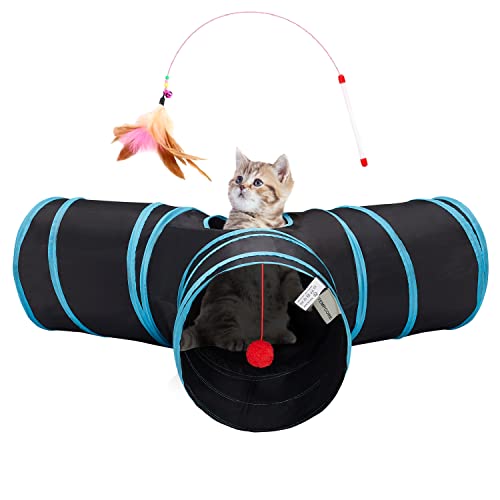
The Tempcore Pet Tunnel Tube Cat Toys is a collapsible tunnel with three openings, a peephole and a dangling ball. It suits kittens and cats that like to crawl, hide and bat at things as they pass through. It is a simple, low-cost option for many indoor homes.
Best use cases
The tunnel fits well in living rooms, bedrooms or hallways where a cat already likes to walk. It can also serve as a hiding place when a cat wants a quiet corner. Because it folds down quickly, it is easy to move between rooms or pack for travel.
Key features in simple terms
The tunnel uses polyester fabric and a spring steel frame. The listing describes the material as not easy to scratch, and it includes protective ends on the frame. Each tube is about 10 inches tall and 17 inches deep, which the listing gives as its size.
The three openings and the peephole create a hide-and-seek setup. The ball on the exits swings when a cat pushes through, which encourages batting and chasing. Because the listing describes the tunnel as more suitable for kittens, larger cats may find it a little snug.
Daily life with the tunnel
In daily use, a tunnel tends to get attention in short bursts. A cat may crawl through a few times, then ignore it for hours. Placing it near a window or a favorite perch can increase how often a cat finds it.
Performance and ease of use
Setup takes almost no time, since the tunnel opens and folds with the frame. The fabric is easy to shape and the frame holds its form during play. The listing states that it folds down small in seconds, which makes storage simple.
Value for money
At $9.99, this is the lowest-priced toy in this group. It offers several ways to play for a modest cost. Buyers who want an inexpensive option that encourages movement may find it a sensible choice.
Pros
- Low price makes it an easy first purchase.
- Folds down quickly for storage or travel.
- Three openings and a peephole support hide-and-seek play.
- Dangling ball encourages batting and chasing.
Cons
- The listing describes it as more suitable for kittens, so adult cats may find it small.
- A tunnel is a passive toy, so it needs the cat to make the first move.
- Fabric tunnels can be chewed or pulled by cats that like to bite soft materials.
- Interest may fade after a few days if the tunnel stays in the same spot.
3. Potaroma Cat Toys Pack of 2: best for chewing, kicking and catnip play
The Potaroma Cat Toys Pack of 2 is a sisal kicker stuffed with catnip. It works as a scratching surface, a pillow and a toy for kicking and chewing. It suits cats that like to bite, wrestle and roll, and it can help with scratching habits.
Best use cases
This toy fits well for cats that like rough play or need a place to scratch. It can also suit teething kittens, since the sisal texture gives them something firm to chew. Placing it near a scratching spot may help redirect claw marks away from furniture.
Key features in simple terms
The toy contains catnip, which many cats respond to with rolling, rubbing and chewing. The sisal is woven, and the listing describes it as tight and no-shed. The edges are double-stitched, and the listing claims the fabric resists bites.
At 9.5 inches by 3.3 inches, the toy is large enough for a cat to hug and kick. The listing says it may help remove plaque through chewing, though it should not replace regular dental care. Because the toy is sold as a pack of two, you get a spare for rotation.
Daily life with the kicker
Catnip effects vary, and some cats do not react to it at all. Cats that do respond often roll and chew for a short time before settling and then nap. Rotating the two toys can keep the scent fresh and the interest higher.
Some cats may shed a little loose sisal fibers, so a quick check during play is a good habit.
Performance and ease of use
No setup is needed, since the toy works as soon as you place it on the floor. The soft, woven surface feels comfortable under a cat’s paws.
The listing says it is sturdy enough for aggressive chewers, but any cat that tears fabric should be supervised during play.
Value for money
At $12.98 for a pack of two, the price per toy is modest for a large, multi-use item. You get a scratcher, a pillow and a kicker in one. Buyers who want a low-tech toy that works without batteries may find it especially useful.
Pros
- Two toys in one pack offer a spare for rotation.
- Sisal texture supports scratching and gentle chewing.
- No batteries or setup are required.
- Large size suits kicking, hugging and rolling play.
Cons
- Catnip does not affect every cat, so results will vary.
- Strong chewers may still tear the fabric over time.
- It works as a passive toy, so it does not move on its own.
- Loose sisal fibers may appear during heavy play.
4. BABORUI Cat Toy Disc Launcher: best for active chasing and fetch
The BABORUI Cat Toy Disc Launcher is a handheld device that shoots flying discs for a cat to chase. It comes with eight discs, including glow discs for dim light. It suits cats that enjoy running, jumping and pouncing, and it also gives the owner a way to join in.
Best use cases
This launcher works best during active play sessions with an owner present. It can help burn energy before meals or bedtime. Because it needs a person to launch the discs, it is a good match for owners who can set aside a few minutes each day.
Key features in simple terms
The launcher uses a one-button system, so you press once to load and launch a disc. The handle is straight and designed to feel comfortable in the hand. The discs are made of ABS plastic, a common, sturdy material, and the set includes five regular discs and three glow discs.
The launcher has a built-in 300mAh battery and charges through a Type-C port. The set also includes four spring toys for extra enrichment. The rustling sound of the spinning discs can attract a cat’s attention quickly.
Daily life with the launcher
In daily use, the launcher is most engaging when a cat has space to run. Short sessions of a few minutes often work better than long ones, since many cats lose interest in repeated launches. The glow discs can extend play into the evening.
Performance and ease of use
The one-button design makes the launcher simple to use, even for children with adult supervision. The handle keeps your grip steady while you aim. Because the battery is small, the listing suggests frequent charging for heavy use.
Value for money
At $9.99, the launcher is one of the lower-priced options here. It includes multiple discs and extra spring toys. Buyers who want an interactive game they can share with their cat may find it a practical buy.
Pros
- Encourages running, jumping and pouncing during play.
- Eight discs, including glow discs, extend the fun.
- One-button launch is simple to operate.
- Rechargeable with a common Type-C cable.
Cons
- It needs a person to launch the discs, so it is not hands-off.
- The 300mAh battery may need frequent charging with heavy use.
- Some cats lose interest quickly in repeated launches.
- Discs may roll under furniture and need to be retrieved.
5. Jkanti Interactive Cat Toys: best for motion-activated play on any floor
[[P RODUCT:B0DG1X5KHM]]
The Jkanti Interactive Cat Toys is a motion-activated ball with an elastic mesh tail. It moves across carpets and hard floors and reacts when a cat touches it. It suits timid cats that prefer slow play and bold cats that want quick, fast bursts.
Best use cases
This ball works well in rooms with mixed flooring, since it is designed for thick carpet, thin carpet and hard surfaces. The slow mode suits older or shy cats, while the fast mode suits energetic adults. Its automatic standby also helps when you are away for a while.
Key features in simple terms
The ball has a flocked and silicone surface that feels fluffy to the touch. The 2.3-inch size suits both adult cats and kittens, according to the listing. A button switches between slow mode, which flashes red before the light turns off, and fast mode, which keeps a blue light on.
The ball enters standby after about three minutes of play. A cat touching it again restarts another cycle, and a bird chirp plays with each activation. The built-in 600mAh battery charges through a Type-C cable, and two tail accessories are included as spares.
Daily life with the ball
In daily use, the ball tends to draw a cat in when it moves unexpectedly. Some cats chase it across the room, while others prefer to watch from a distance. The listing notes that carpet hair can slow the motor, so regular cleaning of the connecting rod helps keep it running at full speed.
Performance and ease of use
The button controls are simple, with one long press for slow mode and a short press for fast mode. The surface is easy to wipe clean. The listing says movement is slightly slower on carpet than on hard floors, which is worth knowing before you buy.
Value for money
At $14.99, this is a mid-priced option in this group. You get motion, sound, two modes and a spare tail accessory. Buyers who want a toy that moves without constant help may find it a fair price for the features.
Pros
- Works on carpet and hard floors, with slightly slower movement on carpet.
- Slow and fast modes suit both shy and energetic cats.
- Automatic standby cycles reduce the need for constant supervision.
- Two tail accessories are included as spares.
Cons
- Carpet hair can slow the motor and needs periodic cleaning.
- The small ball may be easy for a cat to bat away out of reach.
- Battery life depends on use, and the 600mAh cell needs regular charging.
- Motion toys can attract attention but may not hold interest for very long sessions.
Comparison insights: how the five toys differ
The five toys cover different styles of play, so their strengths vary. The Qraxond and Jkanti toys are powered and move on their own. The Tempcore tunnel and the Potaroma kicker are passive, and the BABORUI launcher relies on a person.
Performance depends on what you want the toy to do. Motion toys suit owners who are away, while the launcher suits shared play. Scratching and chewing are the focus of the sisal kicker, and the tunnel suits cats that like to hide.
Ease of use is simplest with the tunnel and the kicker, since neither needs charging. The Qraxond and Jkanti toys need a charged battery and some setup, though both are still straightforward. The launcher is easy to operate but requires a person to be present.
Value for money ranges from the low-cost tunnel at $9.99 to the Qraxond at $31.99. The Potaroma pack offers two items for $12.98. Price alone does not decide value, so match the features to your cat’s habits.
Buying guide: key factors explained in plain words
Start by thinking about how your cat plays. A cat that loves to stalk may enjoy a hide-and-seek toy, while a cat that likes to bite may prefer a sisal kicker. Watching your cat for a few days can show you which movements it responds to.
Next, consider if you want a to justify the price. Automatic toys cost more but keep a cat busy while you are out. Passive toys cost less but need you or the cat to start the play.
Power and charging
Electric toys use batteries that need charging before use. Check which charger the toy needs, since some require a specific adapter. Keep the cable handy so the toy does not sit dead on a shelf.
Size and fit for your cat
Kittens and adult cats differ in size and strength. A small toy may be easy for an adult to swat away, while a large toy may be too bulky for a kitten. Look for size details in the product listing before you buy.
Material and safety
Fabric, sisal and plastic each hold up differently to chewing and scratching. Check that the toy has no loose parts that a cat could swallow. Supervise any new toy during the first few sessions to see how the cat treats it.
Floor type and placement
Some motion toys move more slowly on carpet than on hard floors. Think about where the toy will be used most. A toy that works well on your floor type will hold more interest over time.
Noise and light
Several of these toys include chirps, lights or spinning sounds. Some cats enjoy them, while others find them startling. Choose a toy whose sound and light suit your home and your cat’s temperament.
Who should buy these products: matching buyers to a toy
Owners who work long hours may benefit from an automatic toy. The Qraxond fits those who want a multi-mode play option, and the Jkanti fits those who want a simple motion ball. Both can keep a cat moving while you are away.
Owners on a tight budget may prefer the Tempcore tunnel. It offers hide-and-seek play for a low price and folds away easily. It is a sensible first purchase for kittens.
Owners who want a toy for chewing and scratching may find the Potaroma pack useful. The two-pack setup allows rotation, and the sisal surface supports claw and tooth care. It suits teething kittens and cats that like rough play.
Owners who want to join in play may prefer the BABORUI launcher. It encourages running and pouncing, and it creates a shared activity. It suits households where someone can set aside a few minutes each day.
Final verdict
No single toy suits every indoor cat, so the best choice depends on your cat’s habits and your schedule. Automatic toys are useful when you are away, while passive and shared toys suit daily play. Consider size, power needs, floor type and noise before you buy.
In short, match the toy to what your cat already enjoys. A tunnel for hiders, a kicker for chewers, a launcher for chasers and a motion ball for solo play. Even so, rotating two or three toys often keeps a cat more engaged than one toy alone.
Frequently Asked Questions
How long should I play with my indoor cat each day?
Many cats benefit from several short play sessions a day. Five to fifteen minutes at a time is a common starting point. Watch your cat’s response and adjust as needed.
Are electric cat toys safe to leave alone with my cat?
Many electric toys have automatic shut-off or standby modes. Still, check the product listing and supervise a new toy during the first sessions. Keep cables out of reach and remove the toy if it gets damaged.
Does catnip work on every cat?
No. Catnip affects many cats, but some show no response. Kittens under a certain age often do not react. If your cat ignores catnip, a sisal or motion toy may still hold interest.
How often should I replace cat toys?
Replace toys when they are torn, broken or have loose parts. Check them regularly for small pieces that could be swallowed. Rotating toys can make them feel new for longer.
Can these toys replace playtime with me?
Toys help fill the day, but they rarely replace time with an owner. Cats often enjoy interactive play with a person. Use toys alongside, not instead of, daily play together.
Hi, I’m Mary, the founder of PetGadgetPro.com. I’m a passionate pet lover with a special place in my heart for dogs and cats. I share practical advice and honest insights on pet gear to help pet parents make better choices. My dedicated research team studies products in depth, and our writers create reviews using trusted, authentic sources—so you can feel confident choosing the best for your pets.