Best Leash For Reactive Dogs In 2026
As an Amazon Associate we earn from qualifying purchases.
Walking a reactive dog can feel stressful. A dog that lunges, barks or pulls at the sight of other dogs, people or noises needs a leash that gives you control without making the walk harder. This guide is for beginners who want to understand the options before they spend money. It also helps owners who are not sure if a basic leash, a hands-free design or a training resource is the right starting point.
The five products in this round-up share a common purpose: they are dog leashes or dog-walking accessories built for training, daily walks or active outings. Some focus on a strong, simple rope, while others add padded handles, shock absorbers or a waist belt.
The comparison below rests on the listed features and the typical way each type of product is used. It is not based on personal testing, so use it as a starting map rather than a final ruling.


1. Fida Durable Slip Lead Dog Leash: best simple slip lead for training
This is a slip lead, which is a loop of rope that tightens when the dog pulls and loosens when the pressure is released. It suits owners who want a simple, low-cost tool for short training sessions. Because it has no clip, it works without a collar or harness, though that also means it needs careful handling.
What it is and who it suits
The leash is a 6-foot length of 1/2-inch nylon rope with a metal ring and leather-covered knots. It is sold for medium and large dogs. It suits owners who are comfortable with slip leads and want a light, easy tool for training on a loose lead.
Key features in simple terms
The rope is thick and strong, and it has reflective strips for visibility at night. The loop is adjustable, so you can size it to the dog’s neck or body. An anti-choke ring is included to reduce the risk of the loop tightening too far.
Daily use and real-world feel
In practice, a slip lead feels very direct. When the dog pulls, the loop tightens right away, which can be useful for quick corrections but may feel harsh to some dogs. Because the loop goes around the dog’s body, you need to watch the fit closely during every walk.
Performance and ease of use
The leash is quick to put on and take off. Its performance depends heavily on the handler’s skill, since it offers no padding and no second handle. Beginners should practice in a calm space before using it outdoors.
Value for money
At the listed price, it is one of the lower-cost options in this round-up. You get a simple tool without extras. For owners who only need a basic training lead, that trade-off can make sense.
Pros
- Low price for a simple training tool
- Quick to put on and take off
- Reflective strips help in low light
- Thick rope with leather-covered knots
Cons
- Needs careful handling, as the loop can tighten fast
- No padded handle, so it can be uncomfortable to grip
- Not a good fit for owners new to slip leads
- Works only with a loop, not a standard clip
2. iYoShop Hands Free Dog Leash: best hands-free option for active walks
This is a waist-worn leash that keeps your hands free. It suits owners who jog, hike or need both hands for other tasks. The belt and pouch design shifts the work of holding the leash away from your arms.
What it is and who it suits
The product is a waist leash with a belt, a leash, and a removable zipper pouch. It is a good fit for owners who want to run or walk with the dog while carrying a phone, keys or treats. It is less suited to owners who need a leash for close, slow training work.
Key features in simple terms
Two shock absorbers add a small amount of stretch to the leash, which can soften sudden tugs. A removable pouch holds small items, and a D-ring lets you attach a clicker or poop bag holder.
The waist belt adjusts from 27 to 48 inches, and there are two handles, one at the waist and one near the clip for closer control.
Daily use and real-world feel
Because the leash sits at your waist, the dog’s movements tend to feel less restrictive in your arms.
Many owners find this helpful on long walks or runs. Still, the belt needs a good fit, or it may shift during activity.
Performance and ease of use
The clip is heavy-duty and the handles give you options for different situations. Switching between the waist handle and the traffic handle takes a moment of practice. For reactive dogs, the closer handle is the one to rely on when you need tighter control.
Value for money
At the listed price, this product offers more features than a basic leash. You get the belt, pouch and shock absorbers in one set. Buyers who value hands-free walking will likely see good value, while those who only want a simple lead may not need the extras.
Pros
- Hands-free design keeps both arms free
- Removable pouch holds small items
- Two handles give more control options
- Adjustable belt fits a range of waist sizes
Cons
- Waist design may feel unfamiliar at first
- Less direct control than a standard handheld leash
- Belt fit needs checking to avoid shifting
- More parts to clean and maintain
3. Leash Reactive Dog Training: best training guide for reactive dogs
This is a training book rather than a physical leash. It is designed for owners who want a structured plan for working with fearful or frustrated dogs. It fits well alongside any leash, since the leash is only one part of the work.
What it is and who it suits
The title describes a 10-week plan for dogs that react to other dogs, strangers and sounds. It includes trigger tracking worksheets and a walk routine. It suits owners who like written plans and want to build skills step by step.
Key features in simple terms
A trigger is anything that sets off a reaction, such as another dog or a loud noise. Trigger tracking means writing down when and where those reactions happen. The worksheets help owners spot patterns and track progress over time.
Daily use and real-world feel
Using a plan like this usually means short, regular practice sessions. Owners often find that the worksheets make progress easier to see. Results depend on consistency and on the dog’s own pace.
Performance and ease of use
Because it is a book, it is easy to read at home and bring on walks. The steps are laid out in order, which helps beginners. However, reading alone does not replace hands-on guidance from a qualified trainer when needed.
Value for money
At the listed price, it costs more than most leashes in this round-up. Its value depends on if you want a training structure. Owners who already have a leash and need a plan may find it useful, while those who want equipment only may not.
Pros
- Structured 10-week plan is easy to follow
- Trigger worksheets help track progress
- Useful for owners new to reactive dog work
- Works alongside any leash or harness
Cons
- Not a physical product, so it does not hold or control a dog
- Results depend on steady, regular practice
- Higher cost than the leashes in this round-up
- May not replace in-person help for severe reactions
4. Fida Heavy Duty Dog Leash: best padded leash for daily walks
This is a 4-foot, 1-inch-wide nylon leash with padded handles. It suits owners who want a sturdy, everyday leash for walking, training and blank. Here is where it stops: “It suits owners who want a sturdy, everyday leash for walking, training and” — I must continue from there, beginning mid-sentence.
jogging, hiking or general outings.
The hook is designed for quick attachment, which many owners find convenient.
What it is and who it suits
The leash is 4 feet long and 1 inch wide, made of high-strength nylon webbing. It is sized for medium and large dogs, and it may also suit some smaller breeds.
It fits owners who want a short, firm leash for close walking near traffic or busy areas.
Key features in simple terms
The clasp is a metal snap hook that locks onto the D-ring with a light slide. It rotates a full turn, which helps reduce twisting and tangling. The handles are soft and padded, and a second handle sits near the collar for closer control.
Daily use and real-world feel
A 4-foot leash keeps the dog close, which many owners want on busy sidewalks. The padded handle can make longer walks more comfortable on the hand. Reflective threads add some visibility in the early morning and late evening.
Performance and ease of use
The wider webbing feels solid in the hand, and the swivel clasp helps keep the leash from knotting. Because the leash is short, it offers less room for the dog to move. Owners who want more freedom may prefer a longer length.
Value for money
At the listed price, this leash sits in the middle of the range. You get padding, a swivel clasp and a traffic handle in one product. For owners who want a dependable everyday leash, the features support the price well.
Pros
- Padded handles are comfortable on the hand
- Swivel clasp helps reduce tangles
- Reflective threads add visibility in low light
- Wide webbing feels sturdy for daily use
Cons
- Shorter length gives the dog less room to move
- Not designed for hands-free use
- May feel too short for relaxed, open-area walks
- Size range is best for medium and large dogs
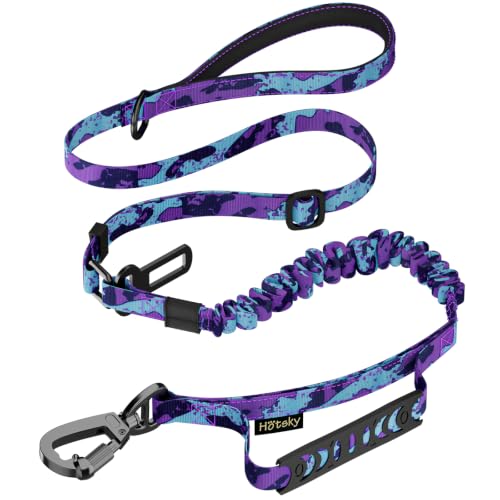
5. Hotsky Tactical Bungee Shock Absorbing No Pull: best bungee leash for strong pullers
This leash includes a bungee section designed to soften sudden pulls. It suits owners with dogs that lunge hard or pull often. Its car seatbelt function adds another use beyond walking.
What it is and who it suits
The leash is 4 to 6 feet long and made of high-density nylon webbing. It includes a bungee section, a padded handle and a traffic handle. It suits owners of medium and large dogs, and owners who want a single leash that also works in the car.
Key features in simple terms
A bungee is an elastic section that stretches and then pulls back. In this leash, it aims to cushion the force of a strong pull. The clasp is an aluminum carabiner with a 360-degree swivel, which helps reduce tangling.
Daily use and real-world feel
The stretch can feel softer on the handler’s arm during a sudden lunge. Because the leash is adjustable in length, owners can choose the setting that suits the walk. The car seatbelt feature is useful for owners who travel with their dog.
Performance and ease of use
The bungee section changes how the leash feels during a pull, so there is a short adjustment period. The traffic handle gives quick control in busy areas. The leash is simple to clip on, though the carabiner can take a moment to handle.
Value for money
At the listed price, it is one of the lower-cost options in this round-up. Buyers get a bungee section, two handles and a car seatbelt feature in one product. For owners who need strong pull control, the feature set adds value.
Pros
- Bungee section softens sudden pulls
- Two handles give more control options
- Car seatbelt function adds extra use
- Swiv el clasp helps reduce tangling
- Adjustable length suits different walks
Cons
- The bungee can feel bouncy to some dogs and owners
- Stretch may reduce direct feedback during training
- Carabiner may take time to open and close
- Works best for medium and large dogs
Comparison Insights: How the Leashes Differ
These five products serve different needs, so the best choice depends on how you walk your dog. A slip lead, a hands-free belt, a training book, a padded everyday leash and a bungee leash each solve a different problem. Looking at performance, ease of use and value side by side makes the differences clearer.
Performance differences
The slip lead gives the most direct response, since the loop tightens right away. The bungee leash softens sudden pulls, while the padded leash offers a steady, short hold. The hands-free belt changes how control feels, because the pull is spread across your waist instead of your arm.
Ease of use differences
The padded leash and the bungee leash are the most familiar for most owners. The hands-free belt takes a little practice to fit and use well. The slip lead is quick to put on, but it asks for more skill when the dog pulls. The training book has no handling demands, though it asks for regular study and practice.
Value for money differences
The slip lead and the bungee leash sit at the lower end of the listed prices. The padded leash and the hands-free belt sit in the middle, with extra features for their price. The training book costs more than the physical leashes, so its value depends on if you need a structured plan.
Buying Guide: Key Factors to Check Before You Buy
Picking a leash for a reactive dog is easier when you know what to look for. Start with your dog’s size, your walking style and your comfort with handling. The factors below apply to most leashes in this category.
Leash length
Length affects how much room your dog has and how close you can keep them. Shorter leashes give more control, while longer leashes allow more movement. Many owners of reactive dogs prefer a length that keeps the dog close near triggers.
Material and strength
Nylon is common because it is strong and light. Webbing is flat and wide, while rope is round and thinner. Thicker, well-stitched materials tend to hold up better during strong pulls.
Handles and grip
A padded handle can make walks more comfortable on your hand. A second handle near the collar gives closer control in busy areas. Consider how the leash feels in your hand before you buy.
Clasp and hook
A secure clasp keeps the leash attached to the collar or harness. A swivel clasp can help prevent twisting. Check that the clasp is easy for you to open and close with one hand.
Shock absorption
A bungee or shock absorber adds some stretch to the leash. This can soften sudden pulls, though some owners prefer a direct feel for training. Think about which feel suits your dog and your style.
Hands-free designs
A waist or hands-free leash keeps your arms free for other tasks. It can suit runners and hikers, but it offers less direct control in some situations. Check the belt fit before you rely on it.
Who Should Buy These Products
Each product in this round-up suits a different type of owner. Matching the product to your needs makes the decision simpler. The notes below describe common buyer types.
Owners who want a low-cost, direct training tool may consider the slip lead. It suits people who are comfortable with slip leads and practice carefully. Beginners should learn proper handling before using it outdoors.
Owners who jog, hike or need both hands free may find the hands-free belt useful. It fits people who want to carry items while walking the dog. Those who prefer close, hands-on control may want a standard handheld leash instead.
Owners who want a structured plan for reactive dog work may choose the training book. It suits people who like written steps and worksheets. It works best alongside a leash and, when needed, support from a qualified trainer.
Owners who want a sturdy, everyday leash for daily walks may prefer the padded leash. It suits people with medium or large dogs who like a short, firm hold near busy areas. Owners who want more room for their dog may look at a longer option.
Owners of strong pullers who also travel with their dogs may consider the bungee leash. It suits people who want cushioning during sudden lunges and a car seatbelt feature. Owners who prefer a direct feel during training may find the stretch less helpful.
Common Mistakes to Avoid
Many owners of reactive dogs make the same few mistakes with their leashes. Avoiding them can make walks safer and less stressful. The points below are easy to remember.
Wrapping the leash around your hand
Wrapping a leash around your hand or wrist can cause serious injury if the dog suddenly pulls or bolts. Always hold the loop or handle securely in your hand. This is especially important with slip leads and bungee leashes.
Picking the wrong length
A leash that is too long can let the dog reach a trigger before you can react. A leash that is too short can feel restrictive and tense for both of you. Pick a length that fits your walking area and your dog’s pace.
Skipping a fit check
A slip lead or hands-free belt that does not fit well can slip, tighten too far or shift during a walk. Check the fit before each outing, not just the first time. This simple habit helps prevent problems.
Expecting a leash to fix everything
A leash controls the dog, but it does not teach calm behavior on its own. Reactive dog work usually needs training, patience and steady practice. A leash works best as one part of a bigger plan.
Ignoring the dog’s comfort
Some dogs react badly to a bouncy bungee or a tight slip loop. Watch your dog’s body language during walks and adjust your gear if needed. Comfort helps the training process go more smoothly.
Final Verdict
No single leash is the right answer for every reactive dog. The best choice depends on your dog’s size, your walking style and how much control you need. The five products here each fill a different role.
For a low-cost, direct training tool, the slip lead is a simple option for experienced handlers. For active owners who want free hands, the hands-free belt offers useful features. For a structured plan, the training book adds guidance that no leash can provide.
For everyday walks, the padded leash offers a comfortable, sturdy hold. For strong pullers, the bungee leash softens sudden force and adds a car seatbelt function. In short, match the product to your dog and your routine, and combine it with steady training for the best results.
Frequently Asked Questions
What is the best leash for reactive dogs?
There is no single best leash for every reactive dog. The right choice depends on your dog’s size, your walking style and your comfort with handling. Many owners prefer a sturdy leash with a secure clasp and a second handle for closer control.
Is a slip lead safe for a reactive dog?
A slip lead can be used safely, but it needs careful handling and a good fit. It tightens when the dog pulls, so beginners should practice in a calm space first. Many owners pair it with training support.
Do I need a bungee leash for a strong puller?
A bungee leash can soften sudden pulls, which some owners find helpful. It is not required for every dog, though. Some owners prefer a direct feel for training, so the choice depends on your preference.
Is a hands-free leash good for reactive dogs?
A hands-free leash can suit active owners who want free hands. It offers less direct control than a handheld leash in some situations. Check the belt fit and practice before using it near triggers.
Should I use a training book along with a leash?
A training book can give structure and help track progress over time. It works best alongside a leash, not in place of one. For severe reactions, support from a qualified trainer may also help.
Hi, I’m Mary, the founder of PetGadgetPro.com. I’m a passionate pet lover with a special place in my heart for dogs and cats. I share practical advice and honest insights on pet gear to help pet parents make better choices. My dedicated research team studies products in depth, and our writers create reviews using trusted, authentic sources—so you can feel confident choosing the best for your pets.