How to Get a Cat in a Carrier?
Getting your cat into a carrier is one of those tasks that can turn even the sweetest kitty into a furry ninja. Your cat vanishes under the bed. They squeeze into impossible spaces. They give you that look—the one that says you’ve betrayed their trust forever.
But here’s the good news: it doesn’t have to be a battle every single time. With the right tricks and some patience, you can make carrier time way less stressful for both of you.
Why Your Cat Freaks Out About the Carrier
Before we jump into solutions, let’s talk about why cats hate carriers so much. Your cat isn’t just being difficult. There’s actually real stuff going on in their head.
Cats are creatures of habit. The carrier means something unexpected is about to happen. Maybe it’s a vet visit. Maybe it’s a car ride. Either way, your cat has learned that the carrier = change, and cats don’t love change.
The carrier also takes away your cat’s control. They like knowing what’s coming. Inside the carrier, they can’t see much, can’t run away, and can’t do their normal escape routes. It feels like being trapped.
Then there’s the physical stuff. Some carriers are uncomfortable. They’re small. They rock back and forth in cars. They get hot. The whole experience just feels bad from a cat’s point of view.
The good news? You can change what your cat thinks about carriers. You just need to approach this differently than most people do.
Start Training Long Before You Need It
This is the secret that most cat owners miss. Don’t wait until vet appointment day to introduce your cat to the carrier. That’s like meeting someone for the first time at their funeral. Bad vibes only.
Instead, bring the carrier out weeks or even months before you need it. Leave it sitting in a room where your cat hangs out. Make it totally normal. Don’t force your cat to go near it. Just let it exist.
Your cat will be curious. Cats are curious about everything. They’ll sniff it. They’ll maybe walk around it. They might even go inside just to check it out. That’s the goal. You want your cat to think the carrier is just another piece of furniture in the house.
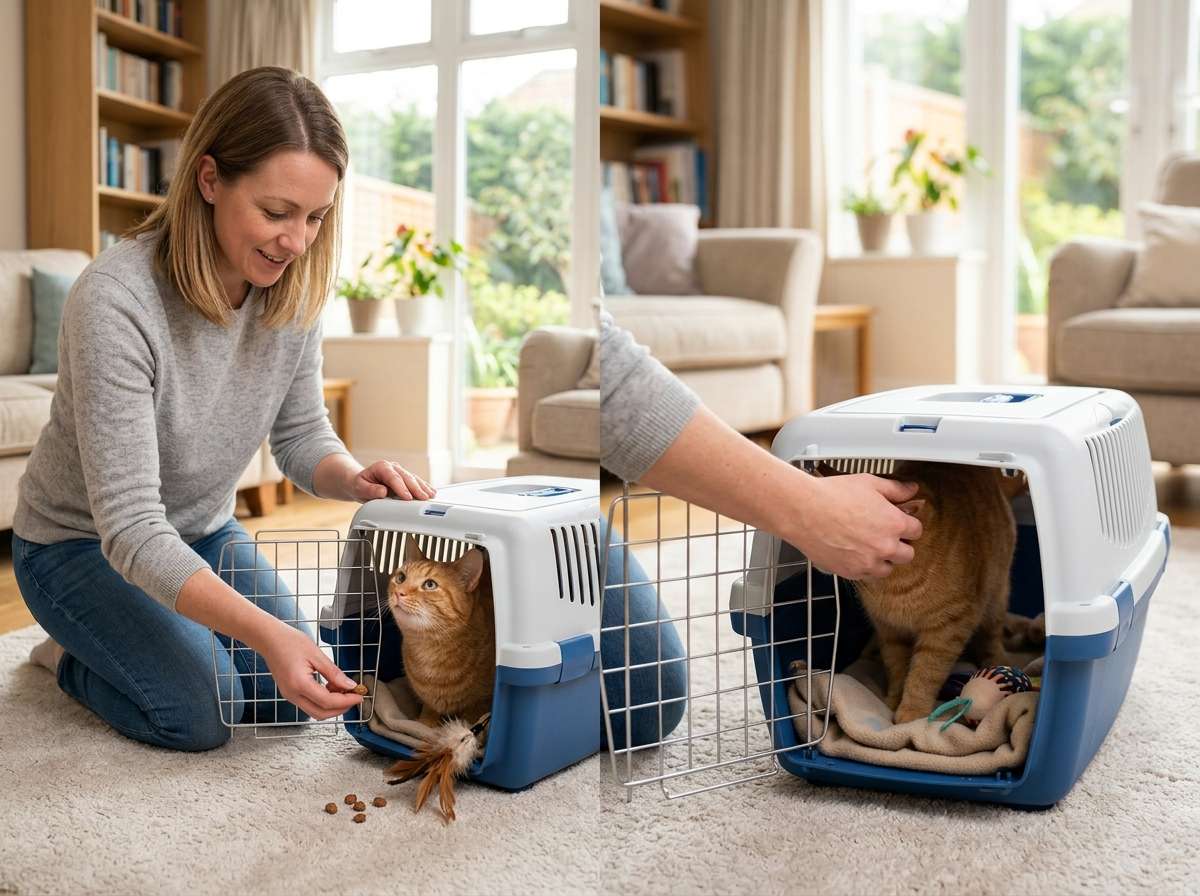
After a few days, try putting some treats inside the carrier. Leave the door open. Let your cat go in and out as they please. They can grab a treat and leave. No pressure.
Keep doing this for a couple of weeks. Make sure good things happen when your cat is around the carrier. Some treats here, some praise there. Your cat starts thinking the carrier isn’t so bad after all.
This step alone makes a huge difference. Cats trained this way are way more chill about getting in a carrier because they’ve already decided it’s safe.
Pick the Right Carrier for Your Cat
Not all carriers are created equal. The wrong carrier makes everything harder.
First, size matters. Your cat needs enough room to stand up, turn around, and lie down. But it shouldn’t be huge. A carrier that’s too big feels unstable, and cats don’t like that. Your cat wants to feel secure, not lost in a giant box.
Some carriers are hard plastic crates. These are tough and easy to clean. Other carriers are soft-sided bags. These are lighter and easier to carry, but they don’t offer as much support.
Here’s a pro tip: hard-sided carriers are actually better for loading cats. Why? Because the top often comes off. You can lower your cat straight down into the carrier instead of trying to stuff them through a small door. This way is way less stressful.
Top-loading carriers are game-changers. Seriously. Instead of your cat fighting to fit through the side opening, you remove the top half of the crate. Your cat goes in vertically. It feels less like being shoved into a space and more like just stepping down.
Make sure the carrier has good ventilation. Your cat needs to breathe. Check that there are vents on multiple sides, not just the front.
Comfort stuff matters too. Put a familiar blanket or towel inside. Your cat likes smells they know. If the carrier smells like home, it feels safer.
Use Treats and Rewards Like a Pro
Food is one of the best tools you have. Cats are motivated by food. Use this to your advantage.
Keep some special treats just for carrier training. These should be treats your cat doesn’t get any other time. We’re talking high-value treats here. Fancy flavors. Real chicken or fish. Something your cat would actually work for.
Here’s the strategy: start by rewarding your cat just for being near the carrier. Cat comes near the carrier? Treat. Cat sniffs the carrier? Treat. Cat puts one paw inside? Big treat.
Then level it up. Reward your cat for going all the way inside. Reward them for staying in there with the door closed for a few seconds. Reward them for staying calm.
The timing matters. Give the treat RIGHT when your cat does the thing you want. Not five seconds later. Right then. Cats need to understand what they’re being rewarded for.
Don’t bribe your cat to get in the carrier on a day you actually need to go somewhere. That’s different from training. Use a calm day. Use multiple short sessions. Five minutes of training is better than one forced fifteen-minute battle.
Master the Technique: Getting Your Cat Inside
When you’ve built up the positive associations and you need to actually get your cat in the carrier, technique matters.
First, set up the space. Put the carrier somewhere your cat can’t just run away into other rooms. Close bedroom doors. Close bathroom doors. Make sure you’re not chasing your cat all over the house.
Put on comfortable clothes. This might take a minute. You don’t want to be stressed. Cats pick up on your stress and it makes them more nervous.
Here’s the actual technique:
Pick up your cat from underneath their belly. Support their bottom. One hand holds under the front chest, one hand supports the back legs and bottom. Your cat needs to feel secure. Don’t grab them by the scruff or pick them up awkwardly.
Approach the carrier calmly and slowly. No rushing. Act like this is totally normal. Your confidence matters.
If it’s a top-loading carrier, remove that top. Lower your cat gently down into the carrier. Let them put their feet down. They should feel in control of how they land.
As soon as they’re in, close the top and secure it quickly but without slamming it. Done.
If it’s a side-loading carrier, this is trickier. You basically want to guide your cat in bottom-first. Hold them level with the opening and gently guide them toward it. Some cats will go in easier if you let them walk in on their own instead of being placed.
Handle Special Cases: The Escape Artist
Some cats are extra clever. They’ve escaped the carrier before. They know tricks. They’re basically furry Houdinis.
For these cats, you need backup. Get another person if possible. One person opens the door and removes the top (if you’re using a top-loader). The other person holds the cat and guides them in. With two people, it’s much faster and harder for the cat to escape.
Make sure everything is ready before you even approach your cat. Have the carrier out. Have it open. Have treats ready. Have everything set up so the whole process takes thirty seconds max.
Some people use a towel or blanket to keep a cat calm. Gently wrap a towel around your cat (not tight, just loose) to keep them from flailing. This actually calms a lot of cats down. There’s something about the gentle pressure that feels secure.
If your cat absolutely loses it, take a break. Forcing a panicked cat into a carrier can stress them out even more. Try again in a few minutes.
Car Rides: Making the Drive Less Awful
So you got your cat in the carrier. Now you’ve got to drive. Car rides stress out cats. They’re loud. They shake. It’s weird.
First, keep the carrier secure. Put it on the floor, not the seat. It can slide around and that’s scary. If you need to put it on a seat, secure it with a seatbelt.
Never put the carrier in the sun. It gets hot fast. Make sure the car is a comfortable temperature.
During the drive, don’t open the carrier. I know your cat is meowing. I know it sounds sad. But opening the carrier while driving is dangerous for both of you.
Some cats do better in the dark. Put a light blanket over the carrier (just the sides, not the whole thing so they can still breathe). The dark calms them down.
Some cars are loud. If yours is, the noise might be making your cat more anxious. Play some soft music to cover the scary sounds.
Keep driving smooth. Jerky turns and sudden stops freak cats out.
And here’s a thing: your cat might throw up in the carrier. It happens. It’s usually stress-related. You can’t really prevent it, but you can prep for it. Use washable blankets or pads in the carrier. Keep paper towels in the car. Clean it up calmly without making a big deal. Getting mad just makes next time harder.
What NOT to Do
Let’s talk about the stuff that makes things worse.
Don’t yell at your cat. Yelling makes them more scared. You’re trying to make the carrier less scary, remember? Yelling does the opposite.
Don’t punish your cat for not cooperating. Punishment and fear don’t teach cooperation. They teach your cat to be even more scared.
Don’t leave the carrier out as a scary symbol. Some people only bring out the carrier when bad things are about to happen. Then they wonder why their cat runs. Make the carrier normal. Leave it out all the time.
Don’t use the carrier as a timeout place. Your cat should never be locked in the carrier as punishment. The carrier is for transport. It shouldn’t be a bad place.
Don’t force your cat in over and over until they give up. That’s not training. That’s torture. Your cat will remember it and it’ll be harder next time.
Don’t grab your cat roughly or squeeze them. Gentle handling is always better. Your cat is way more cooperative when they feel safe.
Dealing with the Noise and Drama
Here’s something real: most cats are going to cry and meow in the carrier. A lot. They’re going to sound absolutely miserable.
This is where you have to stay strong. Your cat is not actually dying. They’re not being hurt. They’re just unhappy about the situation. And that’s okay. You can let them be unhappy.
The worst thing you can do is give in to the noise. If you open the carrier because your cat is meowing, you just taught them that meowing works. Next time they’ll meow more.
Stay calm. Your cat is feeding off your energy. If you’re anxious and stressed, they’re anxious and stressed. If you’re calm and matter-of-fact about it, they’ll settle faster.
Some people play carrier training sounds. These are sounds of cats in carriers, recorded calm and peaceful. Playing these helps your cat learn that other cats are fine in carriers too.
The car is going to be loud anyway. You won’t be sitting home with nothing but your cat’s meowing. You’ll be driving. Focus on driving safely. Let your cat make noise. They’ll stop eventually.
Building a Carrier Routine
The best way to make carrier loading easier long-term is to build a routine. If your cat goes to the vet regularly, make it a schedule. Once a month. Same day. Same time.
Your cat starts expecting it. You load up. You drive. You come back. It becomes normal.
Between vet visits, keep the carrier out. Keep putting treats in it. Keep rewarding your cat for going near it. The carrier just becomes part of life.
Some people even do practice runs. They load the cat in the carrier. They drive somewhere safe. They don’t even get out. Then they drive back home and let the cat out. No stressful vet visit. Just practice.
This seems weird. But it actually works. Your cat learns that getting in the carrier doesn’t always mean something bad is about to happen.
Multiple Cat Households
If you have more than one cat, managing carriers gets trickier.
You can’t just load one cat. The other one watches and learns that something’s wrong. They get anxious too.
The solution is to load the second cat separately. Don’t make a big deal. Don’t catch them while the first cat is already in the carrier. Wait a few minutes. Act like it’s totally normal. Load the second cat.
Some people even make fake runs. Load one cat, drive around the block, bring them back. Makes it less weird.
You also want separate carriers if possible. Some people try to put two cats in one carrier to save space. Don’t. It’s uncomfortable and stressful. One cat per carrier.
If you can, hide the first cat while you’re loading the second. Put them in a separate room. That way the second cat doesn’t watch the first cat getting caught and carried away.
Senior Cats and Medical Issues
Older cats sometimes have health problems that make carriers harder. Arthritis makes it painful to get in and out. Hearing loss means they can’t hear you talking to them soothingly.
For senior cats, take extra time. Make the carrier extra comfortable. Use a cushion so they’re not sitting on hard plastic. Make the opening as easy to access as possible.
If your cat has mobility issues, consider a soft-sided carrier or even a pet stroller for some trips. These are easier to get in and out of.
Talk to your vet about anxiety medicine if your cat is really struggling. Some cats can take calming medication before carrier time. This is especially helpful for older cats or cats with real trauma about carriers.
Creating a Positive Association: Real Examples
Here’s what actually works in real life:
Some people put their cat’s favorite toy in the carrier. When the cat wants the toy, they go in the carrier. The toy becomes associated with good things.
Some people feed their cat meals inside the carrier with the door open. The carrier becomes the place where good food happens.
Some people put catnip in the carrier. Catnip is positive. Carriers are where catnip is. The math works.
Some people just leave the carrier open and let their cat sleep in it sometimes. It becomes a safe space, not a scary space.
The common thread: the cat decided to go into the carrier because something good was in there. Nobody forced them. And that changes everything about how they feel.
When You’re Stressed, Your Cat Knows
Your emotional state matters way more than people realize. If you’re dreading the carrier loading, your cat senses that. They pick up on your tension. They get tense too.
Before you even try to load your cat, take a breath. Remind yourself that you’re doing something responsible. Your cat needs to go to the vet. That’s okay. You’re not being mean.
The calmer and more matter-of-fact you are, the easier it goes. You’re not worried. You’re not mad. You’re just doing a thing that needs to happen.
This mindset actually works. Not just for your cat. For you too. Stress about stress doesn’t help.
The Bottom Line
Getting a cat into a carrier doesn’t have to be a war. It takes planning. It takes patience. It takes doing some training before you actually need it.
But it’s totally doable. Thousands of cat owners do this every day. Your cat can learn that carriers aren’t so bad.
Start with the easy stuff. Leave the carrier out. Put treats in it. Make it normal. Do this for weeks. Your cat will go from hating the carrier to being at least somewhat okay with it.
Then work on the actual loading technique. Pick the right carrier. Use proper handling. Keep your cool.
The first time might still be a little dramatic. That’s okay. It gets easier every single time you do it.
Soon you’ll have a cat who still doesn’t love the carrier but doesn’t fight you tooth and nail either. And that’s a real win in the cat parent world.
Remember: you’re not being mean. You’re being responsible. Your cat gets that on some level, even if their drama suggests otherwise.
FAQ: Common Carrier Questions
Q: How long should I leave my cat in the carrier? A: Only as long as needed. If you’re going to the vet, that’s fine. If you’re going on a long road trip, that’s different. For trips over an hour, plan for breaks. Let your cat rest.
Q: What if my cat refuses to eat treats? A: Some cats are too stressed. That’s okay. Sometimes you can’t train your way out of genuine fear. Talk to your vet about calming options.
Q: Can I leave my cat in the carrier overnight? A: No. The carrier is for transport. Your cat needs real space to move, use the litter box, and get water.
Q: What if my cat pees in the carrier? A: Stress sometimes causes this. Make sure there’s a litter box accessible right after. Use plastic liners in the carrier for easy cleanup. This usually improves as your cat gets less stressed.
Q: How often should I practice? A: If you have a cat that really hates carriers, practice weekly. Just short sessions. A few minutes is enough.
Q: Should I sedate my cat before the vet? A: Talk to your vet. Some cats benefit from calming medication before vet visits. Your vet can recommend what’s safe.
Q: Is it normal for cats to cry in carriers? A: Totally normal. Most cats cry. It doesn’t mean you’re hurting them. It just means they’re unhappy. You can manage it.
Getting your cat in a carrier is a skill. Like any skill, it gets better with practice. Your first attempts might be rough. That’s okay. Keep at it. Work on making the carrier less scary. Use treats and rewards. Stay calm.
Before you know it, carrier time will be something you both handle without total chaos. Your cat won’t love it. But they won’t run and hide either.
And in the cat world, that’s basically a miracle.

Hi, I’m Mary, the founder of PetGadgetPro.com. I’m a passionate pet lover with a special place in my heart for dogs and cats. I share practical advice and honest insights on pet gear to help pet parents make better choices. My dedicated research team studies products in depth, and our writers create reviews using trusted, authentic sources—so you can feel confident choosing the best for your pets.